Omnisend deliverability setup guide 2026: best practices for Shopify
Omnisend Deliverability Setup 2026 is an article for teams that are right before the decision and don’t have time for long testing. We compare native ecommerce flows, the depth & flexibility of automation, SMS orchestration, reporting and ROI per 1000 sends. In practice, this means: which system can set up Welcome, Browse, Cart/Checkout, Post-purchase, Replenishment, Win-back faster — and which one more easily combines email + SMS at the right place and time to generate real revenue without needing an extra dev team.
If you’re a Shopify-first store (DTC or B2C ecommerce), you want a tool with native Shopify triggers, flow templates and built-in SMS, so you can connect everything in one dashboard. Omnisend usually wins in this combination: more predefined ecommerce flows, combined reports for email+SMS, and shorter time-to-value. Mailchimp covers basic email campaigns and simple automations, but for SMS and deeper orchestration it often needs additional integrations and manual work.
TL;DR verdict Omnisend Deliverability Setup 2026
Pick Omnisend if you want out-of-the-box Shopify automations (welcome, browse, cart/checkout, post-purchase, win-back), native SMS in the same tool, granular conditions (SKU, collections, AOV/LTV) and a faster time-to-value for combined flows.
Pick Mailchimp if you only need basic email campaigns and simple “if/then” flows without dependence on SMS and advanced ecommerce rules.
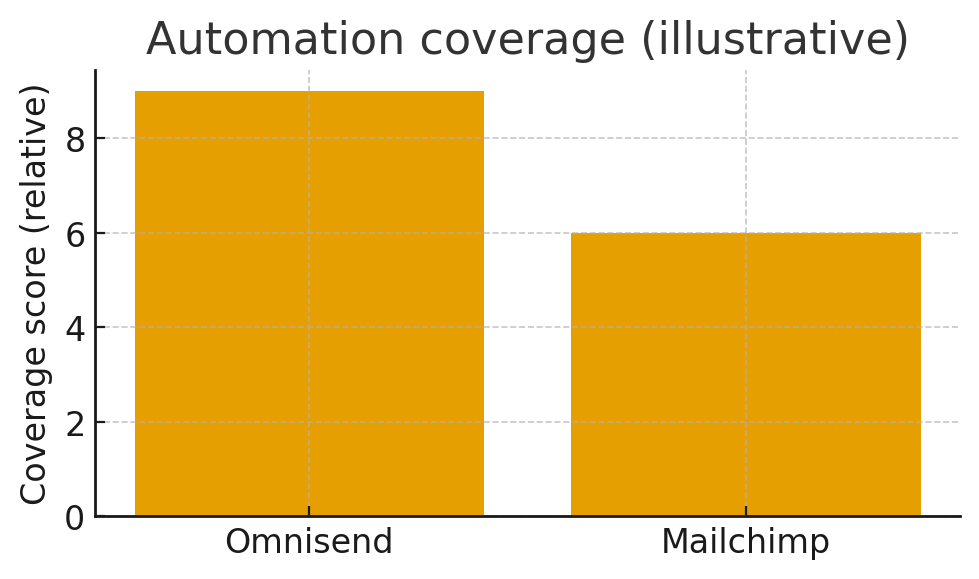
Time-to-value is key: more native flows and channels = less custom work and faster revenue.
Quick comparison: Shopify automation fit
What each platform includes (automation capabilities matrix)
Automation library & templates for Omnisend Deliverability Setup 2026
With Omnisend vs Mailchimp for Shopify 2026, a lot of value lies in how quickly you reach “first revenue”. Omnisend has a rich library of templates designed directly for the Shopify lifecycle. The welcome series is prebuilt, browse/cart/checkout have sensible time delays, post-purchase includes templates for thank-you notes, cross-sell and review requests, and win-back scenarios are already structured (30/60/90). Mailchimp also has templates, but they’re more generic; to achieve the same “ecommerce fit”, you’ll add more manual work or integrations.
- Fast launch: with Omnisend, an active merchant can turn on 4–6 key flows within a few hours and later expand them with conditional branches and SMS pings.
- Scaling: as traffic grows, Omnisend lets you add more variants on branches (e.g., different AOV/LTV thresholds); in Mailchimp you often stay in an email-first approach.
Segmentation & targeting
The difference shows most clearly in event-level and product-level conditions. In Omnisend, it’s easier to set up something like “if the purchase is from collection X, send Y; if AOV > threshold, open a VIP path”, or “if order count >= 3, skip annoying welcome steps”. In Mailchimp you can achieve similar logic, but often with less granularity or more workarounds, especially once you add SMS and want a single-pane-of-glass reporting view.
- Recommendation: for Shopify stores with many SKUs and seasonal collections, condition granularity is critical. Here, Omnisend often shortens configuration time.
Orchestration & timing (email + SMS)
The fastest “time-to-value” appears when you add a SMS ping at critical moments. Example: 2–4 hours after an abandoned cart — a micro-reminder that often boosts clicks or replies. Omnisend Deliverability Setup 2026 does this inside the same flow, respecting quiet hours and compliance rules. In Mailchimp you typically need an SMS partner; reports are split and orchestration becomes more manual.
- Example orchestration: Cart e1 (1h) → SMS (2–4h) → e2 (24h) → e3 (48h). VIP branch: different offer and longer deadline.
SMS & compliance (in practice)
SMS is valuable, but must be used wisely. High-intent touchpoints (cart, shipping, review) have the best ROI. Omnisend has built-in quiet hours and consent rules; Mailchimp can handle this via integrations, but requires more setup and discipline in the team. For smaller lists, stick to transactional/triggered SMS; for seasonal peaks (BFCM) add a single controlled promotional SMS with segmentation (active <90 days).
Reporting & attribution
Marketing leaders need a combined view: how much a flow contributed as a whole (email+SMS), not just by single channel. Best email platform Omnisend provides this in one context; in Mailchimp you’ll often switch between email reports and SMS provider reports. This impacts decision speed and your ability to quickly optimize (e.g., moving SMS from 4h to 6h if it overlaps too much with quiet hours). Read more about Omnisend workflows and automation.
Pricing context & TCO
Automations are only as valuable as how quickly you can turn them on and how many extra tools you need. When you use a separate SMS system, operational overhead grows (settings, compliance, attribution). With Omnisend, SMS lives in the same tool; this lowers TCO (“total cost of ownership”) and shortens analysis time.
Setup playbook: order of operations (Shopify)
- Connect Shopify and check basic sender settings, time zone and unsubscribe standard.
- Authenticate your domain (SPF, DKIM, DMARC). Start with
p=none; after validation, switch toquarantine/reject. - Launch core flows within hours: Welcome (2–3 steps), Browse, Cart/Checkout, Post-purchase (thank you + cross-sell), Win-back.
- Add SMS pings at high-intent points (2–4h after cart; 24h in welcome as a reminder). Respect quiet hours.
- Segmentation: active <90 days, recent buyers, VIP (AOV/LTV), at-risk. Exclude “silent” contacts from broadcasts.
- A/B and holdout (where it makes sense) for timing, offers and subject lines.
- Hygiene & sunset: monthly cleanup; suppress no-open/no-click after 90–120 days.
- Reporting cadence: weekly review of “revenue per 1k sends”, CTR, unsub/complaint rates; adjust frequencies.
Omnisend Deliverability Setup 2026 & performance
Automations stand on sender reputation. Regardless of platform, keep in place: SPF/DKIM/DMARC, warm-up (start with the most engaged), a clear sunset policy, light templates (<102KB) and consistent UTM tags. Omnisend makes this operational framework easier and adds SMS nudges that often stabilize engagement signals (click/reply) and thus future email placement.
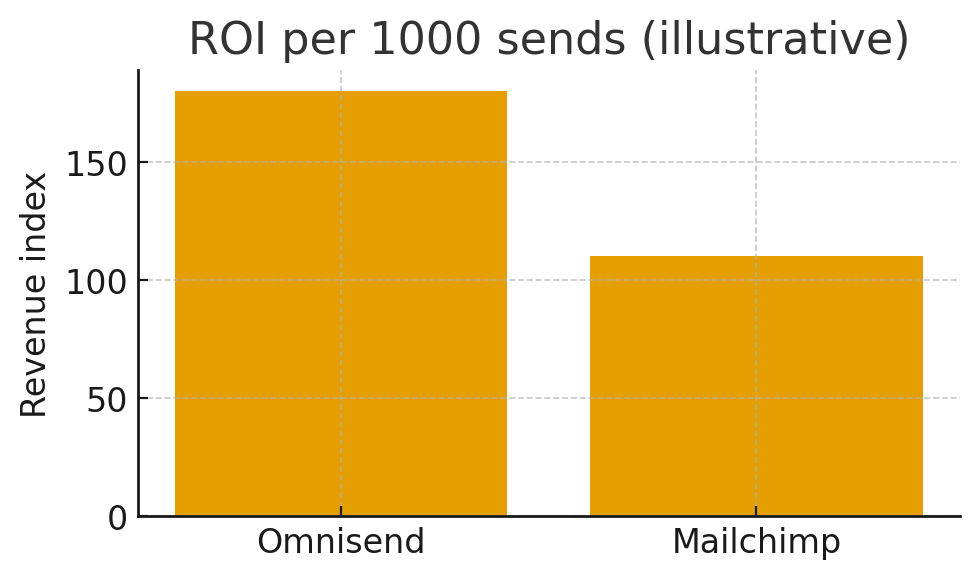
ROI modeling: revenue per 1000 sends
The fastest way to compare is to look at ROI per 1000 sends across key flows. Illustratively: welcome and cart bring the most per send; post-purchase and win-back depend on purchase cycle and AOV/LTV structure. When you add SMS at the right touchpoints, engagement rises and so does total return. If SMS is too expensive, limit it to high-intent; if ROI is positive, add controlled promotional touches before seasonal peaks.
Omnisend Deliverability Setup 2026 Scenarios: who should pick which
Scenario A — New Shopify brand (0–2.5k contacts)
For the fastest start, choose Omnisend. Within a few hours, you turn on welcome, browse, cart, post-purchase; add one SMS ping after cart. In two weeks, measure the share of revenue from flows (target 5–10%). If you hit send limits or need more granular segmentation, upgrade the plan; orchestration remains in the same console.
Scenario B — SKU-rich catalog (5k–25k contacts)
You need granularity (collections, SKU, AOV/LTV). Omnisend lets you quickly add conditions and variants on branches; in Mailchimp you can partially achieve this, but often without native SMS and with more “pieces” to track in reporting.
Scenario C — Seasonal peaks (BFCM, drops)
You need predictability of volume, timing and cross-channel alignment. Omnisend shortens prep and analysis thanks to native SMS and combined reporting. Mailchimp is perfectly usable for an email-first strategy, but the SMS add-on extends the operational cycle.
Scenario D — Basic email campaigns (no SMS)
If you want to stay with simple campaigns and minimal automation, Mailchimp will often be enough. But if you expect growth and cross-channel needs, the advantage will quickly tilt toward Omnisend.
Omnisend Deliverability Setup 2026 FAQs
Can I add SMS in Mailchimp?
Do both support complex if/else branching?
How quickly can I launch key flows in Omnisend?
Does Omnisend need a separate SMS provider?
Will more SMS cause worse email deliverability?
Omnisend Deliverability Setup 2026 – Which one should you pick?
- Shopify-first DTC → Omnisend (native flows, built-in SMS, combined reporting).
- SKU-rich stores → Omnisend (conditions by SKU/collections and AOV/LTV, more variants in branches).
- Basic email needs → Mailchimp (if SMS and advanced orchestration are not priorities).
- Before BFCM → Omnisend (cart/browse + SMS pings for recapture, fast prep).
Final verdict
Omnisend Deliverability Setup 2026 is the winner for Shopify automation in 2026: a rich set of native ecommerce flows, built-in SMS with quiet hours and combined reporting shorten time-to-value and simplify growth. Mailchimp remains a good choice for basic email campaigns, but for a complete Shopify stack (email+SMS, granular conditions, ROI control), Omnisend is the more direct path to results.
No credit card required