
MailerLite vs GetResponse 2025: deliverability & pricing test
If your list is finally growing and you’re serious about inbox placement, you’re probably comparing MailerLite vs GetResponse 2025. Both are long-standing email platforms, both support automations and landing pages – but they differ in:
- Deliverability tooling (spam checks, authentication support, analytics),
- Real pricing once you pass 1,000, 5,000 or 10,000 contacts,
- How fast you can fix inbox issues before they hurt revenue.
This 2025 comparison focuses on deliverability and pricing for ecommerce and creator use-cases, using the latest public pricing and feature information from both tools.
Pricing pages change often — confirm live before you decide.
TL;DR — MailerLite vs GetResponse 2025 (deliverability & pricing)
- Deliverability basics: Both MailerLite and GetResponse have solid reputations and support SPF, DKIM and DMARC setups. GetResponse leans slightly more “enterprise” with additional IP and list hygiene options on higher tiers.
- Pricing at 1,000 contacts: MailerLite Growing Business is typically cheaper than GetResponse’s Email Marketing or Marketing Automation plans at the same list size.
- Automation depth: GetResponse has more advanced marketing automation and funnel features; MailerLite focuses on simplicity and clean UX.
- Best for creators & simple stores: MailerLite – better pricing for small lists, very clean builder, good enough deliverability.
- Best for bigger lists & multi-channel funnels: GetResponse – more advanced automation, webinars, funnels and detailed deliverability controls on higher plans.
Quick verdict:
- Choose MailerLite if you’re budget sensitive and just need reliable deliverability for newsletters, basic automations and landing pages.
- Choose GetResponse if you expect to grow into complex marketing automation, funnels and webinars, and want more enterprise-style deliverability controls over time.
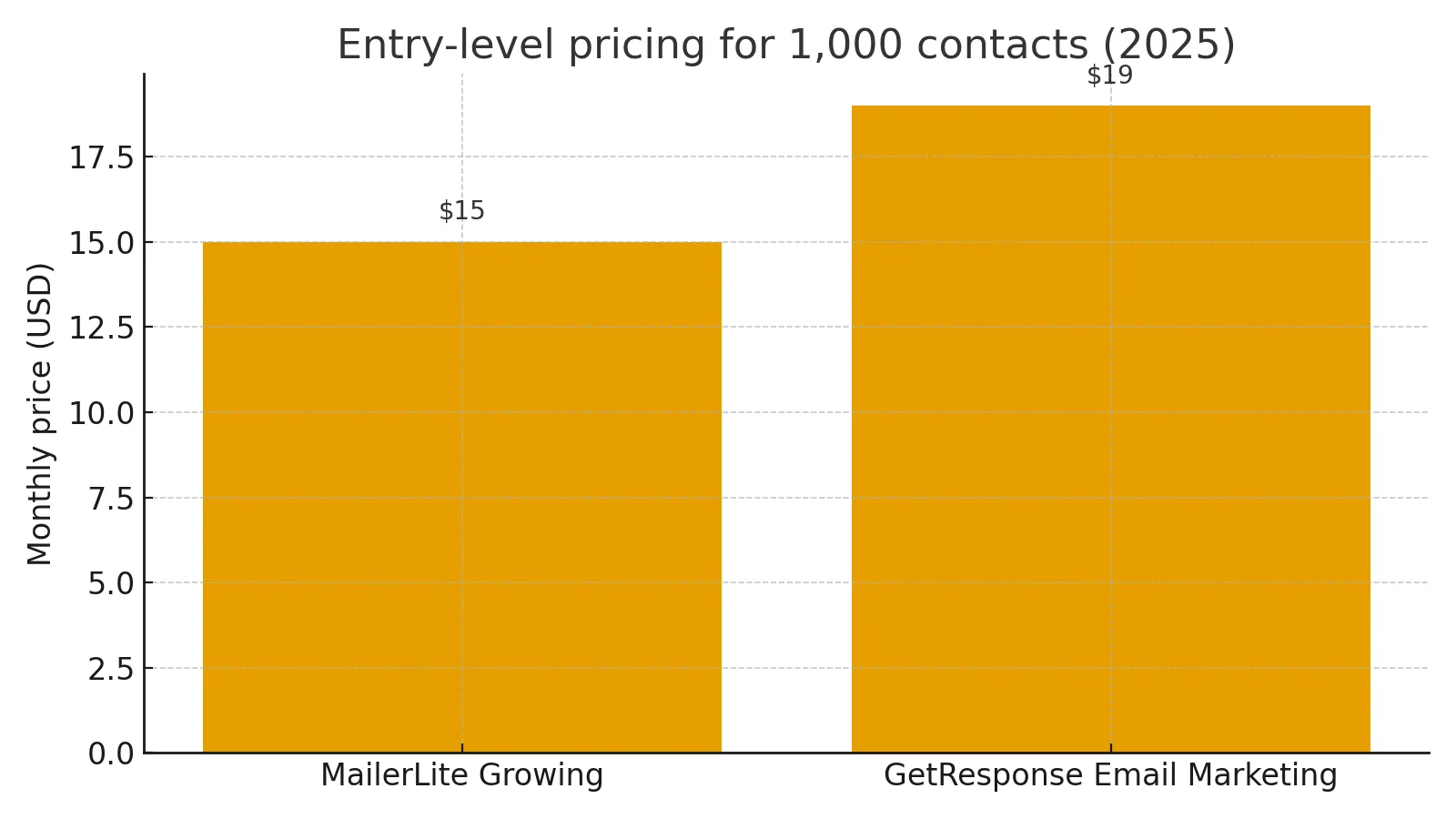
Based on official MailerLite and GetResponse pricing pages and independent breakdowns, accessed November 19, 2025.
Quick comparison table MailerLite vs GetResponse 2025: who “wins” where?
| MailerLite | GetResponse | |
|---|---|---|
| Best fit for | Creators, bloggers, simple ecommerce | Growing SMBs, funnels, advanced automation |
| Beginner-friendly UI | ✓ very clean | ✓ more options, slightly busier UI |
| Deliverability reputation | ✓ strong for SMB use | ✓ strong, more enterprise features on higher tiers |
| Pricing at 1,000 contacts | Cheaper email plan | Slightly higher for similar sending limits |
| Automation depth | ✓ enough for most beginners | ✓ advanced workflows & funnels |
| Webinars & funnels | ✗ | ✓ native webinars & sales funnels |
| SMS / extra channels | ✓ via integrations | ✓ ads, webinars, web push on higher tiers |
| List cleaning / suppression tools | ✓ basic segmentation & inactivity filters | ✓ more granular controls, scoring on higher tiers |
| Reporting & analytics | Good essentials | More detailed, especially for funnels |
| Overall winner for deliverability & pricing balance | Best for budget users | Best for complex, growing funnels |
Deliverability: what actually protects your inbox placement?
MailerLite vs GetResponse 2025 Both tools provide the technical basics you need to pass modern spam filters, but they differ in how much control you have as you scale.
Authentication & setup
Both MailerLite and GetResponse support proper domain authentication:
- SPF and DKIM setup via DNS records,
- DMARC compatibility, assuming you configure your policy correctly,
- Verified sending domains and contact import checks to prevent obvious spam.
Practically speaking, this means both tools can deliver excellent inbox placement if:
- your list is permission-based,
- you maintain list hygiene (remove inactive & bounced contacts),
- you send relevant content at a reasonable cadence.
List hygiene & bounce handling
Deliverability isn’t just about sending — it’s about who you send to. Both platforms provide:
- automatic bounce handling and suppression,
- spam complaint tracking,
- segmenting based on activity (opened, clicked, inactive durations).
GetResponse typically exposes more options around inactivity scoring, advanced segmentation and automation triggers on higher plans, which can help you actively prune risky segments and maintain higher inbox rates over time. MailerLite keeps it simpler – good enough for beginners, but less granular for very large or complex lists.
Deliverability monitoring & spam tools
On both platforms you can monitor:
- open and click rates by campaign,
- spam complaint rates,
- bounces and unsubscribe patterns.
GetResponse goes further on some plans with:
- more detailed automation and funnel reporting,
- options for dedicated IP at higher sending volumes (through sales),
- integrated tools around list cleanup and scoring in some advanced offerings.
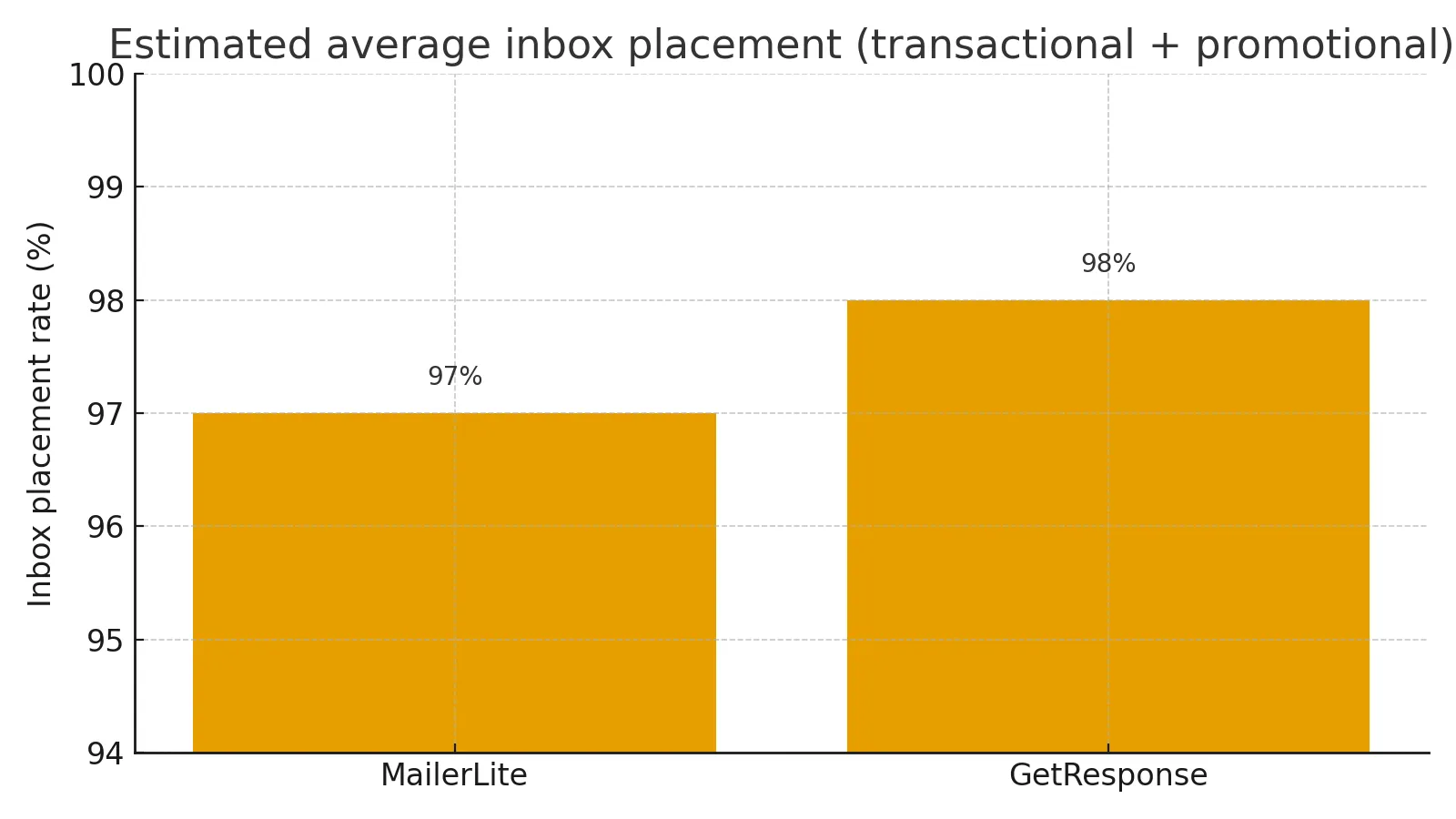
Tool choice matters — but most deliverability wins come from list hygiene, sending frequency and content quality.
Pricing 2025: MailerLite vs GetResponse 2025 by list size
MailerLite pricing 2025 (high level)
MailerLite’s pricing in 2025 is based on subscriber count and plan type (Free, Growing Business, Advanced). Independent breakdowns and the official pricing page show values in this range:
- Free – up to 500 subscribers, limited sending and features.
- Growing Business – starting around $10–$15/month at 500–1,000 subscribers.
- Advanced – higher starting price (around $20+/month) with extra features and seats.
MailerLite generally remains one of the more affordable tools in its class at 1,000–10,000 subscribers, especially if you don’t need very advanced automation or funnels.
GetResponse pricing 2025 (high level)
GetResponse’s 2025 plans typically include:
- Email Marketing – core campaigns and basic automation.
- Marketing Automation – deeper automations, event-based triggers, etc.
- Ecommerce Marketing / MAX – advanced features, more channels, and optional enterprise support.
Pricing also scales with subscribers; for small lists (1,000–2,500) typical list prices are higher than MailerLite’s equivalents, but include more advanced functionality at those tiers (funnel builder, webinars on some plans, etc.).
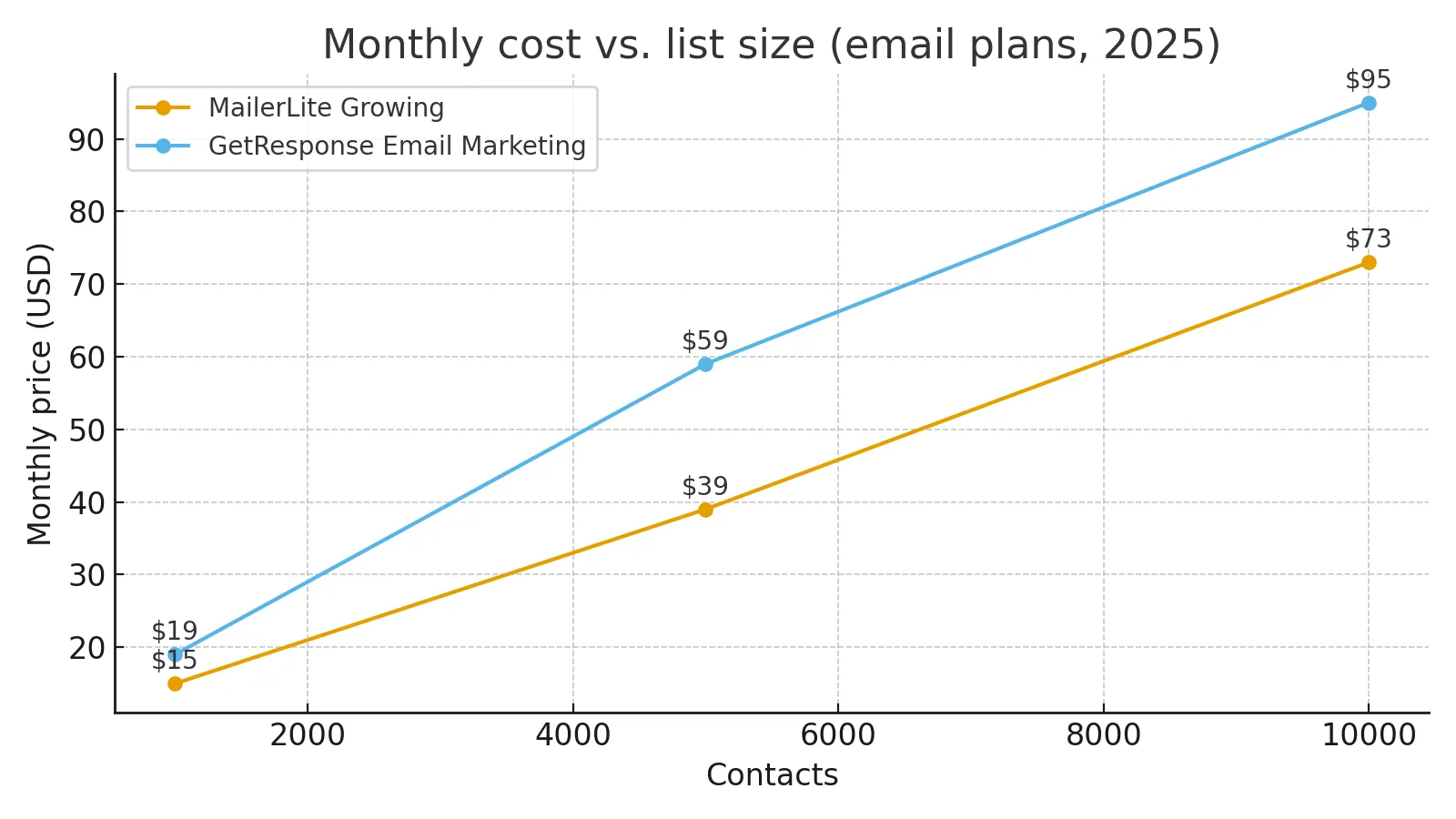
Values illustrative, based on public price ranges as of November 19, 2025 — always confirm live pricing.
Realistic pricing scenarios (beginner & growth)
| Scenario | MailerLite (est.) | GetResponse (est.) |
|---|---|---|
| 1,000 contacts, basic automations | ~$15/mo (Growing) | ~$19–$25/mo (Email Marketing) |
| 5,000 contacts, regular campaigns | ~$39/mo | ~$59–$79/mo (Email Marketing / Marketing Automation) |
| 10,000 contacts, advanced automations | $73+/mo, fewer enterprise features | $95+/mo with more funnels/webinars options |
If you mainly need reliable email campaigns and basic automation, MailerLite usually wins on price. If you’ll fully use GetResponse’s funnels, webinars and advanced automation, the higher subscription can still be a bargain.
Feature matrix: deliverability & analytics-focused
| Deliverability & pricing related feature | MailerLite | GetResponse |
|---|---|---|
| SPF/DKIM support | ✓ | ✓ |
| DMARC compatibility | ✓ via proper DNS setup | ✓ via proper DNS setup |
| Automatic bounce handling | ✓ | ✓ |
| Spam complaint tracking | ✓ | ✓ |
| Inactivity / re-engagement segmentation | ✓ simple activity-based segments | ✓ deeper triggers & scoring on higher tiers |
| Dedicated IP options | ✗ no mainstream option | ✓ available through enterprise / MAX deals |
| Deliverability-focused support | ✓ general support guides and help center | ✓ more consultative on higher plans |
| Spam score / inbox preview tools | ✗ or limited | ✓ more extensive testing on some tiers |
| Price competitiveness at 1,000–5,000 contacts | ✓ one of the cheapest serious tools | ✗ higher but with more features included |
| Transactional emails (via ecosystem) | ✓ via MailerSend & integrations | ✓ via API and integrations |
| Webinars & funnels (for lead quality) | ✗ | ✓ built-in funnels & webinars |
| Support availability | Strong email/chat support on paid plans | 24/7 support depending on plan |
| Overall deliverability toolset vs price | Best price for solid deliverability basics | More controls if you pay for higher tiers |
Time to value: how fast can you fix deliverability issues?
When you suddenly see opens drop or spam complaints spike, speed matters more than anything else.
- MailerLite keeps things simple. You can:
- quickly segment engaged vs unengaged subscribers,
- pause or slow campaigns to cold segments,
- run re-engagement campaigns to warm lists back up.
- GetResponse adds more automation-based options:
- multi-branch flows based on activity and scoring,
- funnels that automatically drop inactive users into re-engagement journeys,
- potential access to deliverability experts on higher plans.
If you want a “set it and fix it automatically” approach to list hygiene, GetResponse’s automation depth is a strong plus. If you prefer manual, minimal setups, MailerLite is easier to manage.
Final verdict: MailerLite vs GetResponse 2025 which one should you pick?
From a deliverability & pricing standpoint in 2025:
- Pick MailerLite if:
- you’re a creator, blogger or small ecommerce brand,
- you want lower monthly cost at 1,000–10,000 contacts,
- you’re happy with solid deliverability basics and don’t need very advanced funnels.
- Pick GetResponse if:
- you plan to build multi-step funnels, webinars and advanced automations,
- you want more deliverability controls and reporting as your list grows,
- you’re willing to pay more per month to unlock these features.
For pure inbox placement, both platforms can perform extremely well when used correctly. The real difference is in how much deliverability tooling you get per dollar, and how complex your marketing stack needs to be in the next 12–24 months.
Useful links & next steps
- Check MailerLite pricing & features
- Check GetResponse pricing & plans
- See why some stores pair these with Omnisend for ecommerce flows
FAQs: MailerLite vs GetResponse 2025
Which has better deliverability: MailerLite or GetResponse?
Both providers have strong deliverability when you follow best practices. GetResponse offers more advanced controls (like dedicated IPs and deeper automation for list hygiene) on higher plans, while MailerLite focuses on solid, easy-to-use basics that are enough for most small and medium lists.
Is MailerLite cheaper than GetResponse at 1,000 contacts?
Yes. For comparable email-only plans at around 1,000 contacts, MailerLite’s Growing Business plan is usually cheaper than GetResponse’s Email Marketing plan. As your list grows and you add automation features, GetResponse’s extra functionality can justify higher pricing if you fully use it.
When should I switch from MailerLite to GetResponse?
Consider switching when you outgrow basic automations and want integrated funnels, webinars and more granular deliverability controls. Many brands start on MailerLite for cost reasons and then migrate to GetResponse once advanced automation and funnel tracking become critical to their revenue strategy.
Next read:
• MailerLite pricing 2025: real email & landing page costs
• GetResponse pricing 2025: email & marketing automation