Why small ecommerce stores must reduce Facebook ads dependence now
If you run a small ecommerce store, you already feel it: every change in Facebook Ads delivery, every CPM spike and every random rejection hits your revenue directly. When acquisition depends on a single channel, your cash flow is fragile. The goal of this guide is simple — show you how to reduce Facebook ads dependence without killing your growth.
This is not a theory piece. We’ll walk through a practical framework: move a portion of the money you currently burn on Facebook into owned channels (email + SMS), automation flows and retention tactics that keep customers buying again and again. Tools like Omnisend make this realistic even for a one-person team.
Instead of asking “How do I scale my ads?”, this guide helps you ask a better question: “How do I make every buyer worth more, so I can safely spend less on ads?” That mindset shift is how you systematically reduce Facebook ads dependence while keeping revenue stable or growing.
TL;DR – The fast path to reducing Facebook ad dependence
- Stop thinking “more ads = more growth”. Start thinking “better retention = safer growth”.
- Move 15–30% of your current Facebook budget into email + SMS automation over the next 60 days.
- Set up 5 core flows (Welcome, Browse, Cart/Checkout, Post-purchase, Win-back) to capture and monetize every visit.
- Use segmentation and personalization to make email feel like a continuation of your store experience, not a generic newsletter.
- Measure “Revenue per subscriber” and “Revenue per 1,000 sends” as your main guardrails.
- Within 1–3 months, the extra revenue from automation makes it safer to reduce Facebook ads dependence without panic.
If you want a deeper dive into personalization tactics that increase every send’s value, pair this guide with the framework in Breakthrough email personalization tactics for small ecommerce.
CTA – Start building your “less ads, more automation” engine
Instead of building everything from scratch, you can plug your store into ready-made ecommerce flows and focus on strategy, not setup.
Quick comparison: Ads-only vs retention-focused growth
Before we go into tactics, here’s how different strategies stack up over 6–12 months. This table makes it clear why it’s dangerous to rely on one channel — and why brands that reduce Facebook ads dependence early usually survive volatility better.
| Growth approach | Short-term result | 12-month outcome |
|---|---|---|
| Only Facebook & Instagram ads | Quick spikes when campaigns work | Revenue swings, fragile cash flow, dependence on platform rules |
| Ads + occasional newsletters | Some extra sales from existing list | List under-monetized, no systematic way to reduce Facebook ads dependence |
| Ads + automated email & SMS flows | Stable baseline from flows + better ROAS | Higher LTV, safer to cut ad spend and reinvest into retention engine |
| Retention-first, ads as amplifier | Slower start, but compounding revenue | Owned audience drives most revenue; ads only amplify what already works |
Ad platforms change faster than you can rewrite your funnels. Your email & SMS list is the only channel you truly own.
What “reduce Facebook ads dependence” really means in practice
Reducing Facebook ad dependence does not mean turning off campaigns and hoping for the best. It means gradually shifting your growth engine from “pay to reach strangers” toward “profit from people who already know you”.
In practice, that looks like this:
- You intentionally collect emails & phone numbers on every key step of the journey.
- You build flows that convert browsers into buyers, and buyers into repeat buyers.
- You use ads to feed the top of the funnel, while your automations handle the downstream revenue.
- You track how much revenue your list generates so you know how aggressively you can reduce Facebook ads dependence without hurting total sales.
When your list and automations generate a predictable baseline of revenue each month, Facebook becomes an amplifier, not a life-support machine.
The 3-pillar framework: from ad addiction to owned growth
To systematically reduce Facebook ads dependence, we’ll base your strategy on three pillars:
- Capture – turn paid and organic traffic into subscribers.
- Automate – build flows that turn subscribers into customers and repeat buyers.
- Optimize – measure revenue per subscriber, not just ROAS.
Pillar 1: Capture – every visit should be an asset
If you drive traffic (paid or organic) to your store and let visitors leave without joining your list, you’re renting attention instead of owning it. The capture pillar focuses on fixing that leak.
- High-intent popups triggered on exit intent or time-on-site.
- Embedded forms on product and blog pages.
- Post-purchase checkboxes for email & SMS opt-in.
- Lead magnets that match your products (guides, quizzes, sizing tools).
Even a simple “10% off your first order” incentive, combined with smart timing and design, can double your capture rate. Tools like Omnisend let you build these without coding and sync everything into automation flows automatically.
Pillar 2: Automate – flows that print revenue quietly
Once capture is in place, every new subscriber should enter a journey. Instead of manually blasting campaigns, you design flows once and let them run 24/7. This is the heart of how you reduce Facebook ads dependence without adding more work.
For a deeper breakdown of automation building blocks, you can follow the engine from cost-saving Omnisend automation templates every store needs and adapt it to your niche.
Pillar 3: Optimize – measure what actually matters
Most store owners only look at ROAS and top-line revenue. When your goal is to reduce Facebook ads dependence, three metrics matter more:
- Revenue per subscriber (RPS) – how much each contact is worth over 30/60/90 days.
- Revenue per 1,000 sends – how valuable each email/SMS send is.
- Automation vs campaign split – how much revenue is generated by flows vs one-off campaigns.
When RPS and revenue per 1,000 sends are rising, it’s a signal that you can safely pull back ad spend and still grow overall revenue.
Features matrix: which tactics actually reduce Facebook risk?
Not all tactics contribute equally to your goal. This matrix shows which retention and automation features directly help you reduce Facebook ads dependence, and which are “nice to have” but not critical.
| Tactic / Feature | Impact on ad dependence | Notes |
|---|---|---|
| Welcome discount flow | ✓ | Converts ad clicks into first-time buyers faster, boosting ROAS and LTV. |
| Browse abandonment flow | ✓ | Recovers warm traffic without paying for retargeting ads every time. |
| Cart & checkout abandonment flow | ✓ | Directly replaces a portion of retargeting spend with owned reminders. |
| Post-purchase cross-sell flow | ✓ | Increases AOV & LTV so you can spend less to acquire each customer. |
| Win-back & replenishment flows | ✓ | Keeps customers active longer, reducing the need for constant new acquisition. |
| Plain monthly newsletter | ✗ | Unpredictable revenue, doesn’t scale like flows. |
| Deep segmentation & personalization | ✓ | Makes every send more profitable, accelerating your path to reduce Facebook ads dependence. |
Visual #1 – Revenue split: ads vs automation over 12 months
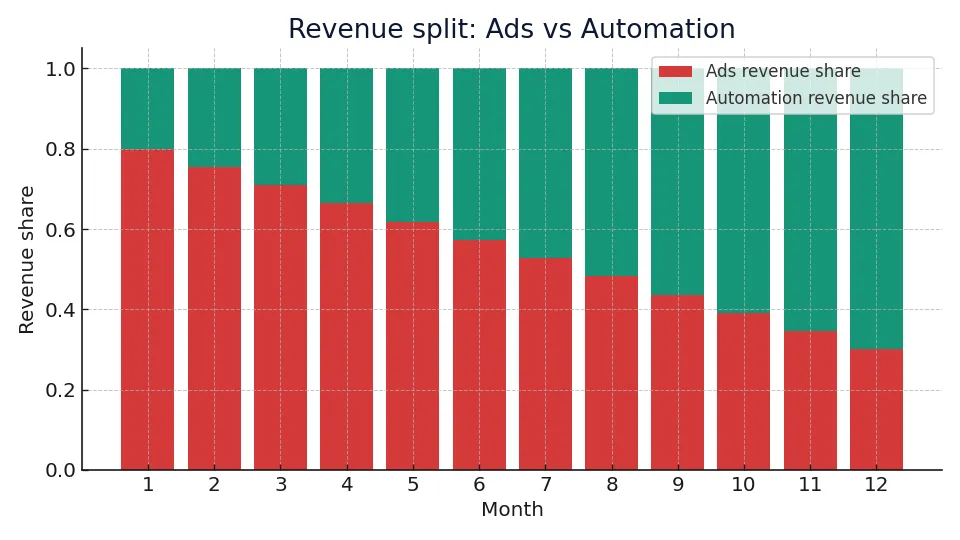
Automation = revenue while you sleep. Set once, and every new subscriber enters a journey that reduces your dependence on any single ad platform.
Map your current situation before you touch budgets
Before you decide how aggressively to reduce Facebook ads dependence, you need a clear snapshot of where you are today. Spend 30–45 minutes capturing:
- Average monthly ad spend on Facebook & Instagram.
- Percentage of revenue attributed to paid vs email/SMS vs other channels.
- Number of active subscribers (email + SMS).
- Existing flows in your account (if any) and their revenue share.
Most small stores discover two things: (1) email/SMS revenue is lower than it could be, and (2) they rely on ads for 60–90% of new orders. That’s exactly the profile where a retention engine can make the biggest difference.
The 5 flows that make Facebook less scary
To move from theory to implementation, start with five battle-tested flows. These are the backbone of most ecommerce retention strategies and a big reason Omnisend is so popular among growth-focused small stores.
1. Welcome flow: turn traffic into subscribers and buyers
Every visitor who gives you their email or phone number should immediately enter a Welcome flow. This is where you set expectations, deliver the promised incentive and tell your story.
- Email 1: Deliver incentive + top 3 benefits of your product.
- Email 2: Social proof + bestsellers.
- Email 3: Education + subtle urgency (stock, season, limited offer).
When set up well, your Welcome flow can generate a significant share of your monthly revenue. That extra baseline makes it much easier to reduce Facebook ads dependence without sacrificing total sales.
2. Browse abandonment: recover “window shoppers” without retargeting ads
Browse abandonment flows trigger when someone views products but doesn’t add to cart. Instead of paying for dynamic remarketing ads every time, you can send automated, highly relevant reminders via email and SMS.
- Show the exact products they viewed.
- Add social proof (reviews, UGC).
- Offer a low-friction next step (size guide, quiz, FAQ).
3. Cart & checkout abandonment: owned reminders first, ads second
Abandoned cart campaigns are one of the highest-ROI flows in Omnisend and similar tools. They also massively help reduce Facebook ads dependence because they recover potential buyers who would otherwise only see your retargeting ads.
- Email/SMS 1: Simple reminder with product + CTA.
- Email/SMS 2: Overcome common objections (shipping, returns, quality).
- Email/SMS 3: Optional limited-time incentive for high-intent segments.
When you lean on owned reminders first, you can lower retargeting budgets and still capture a large share of abandoned checkouts.
4. Post-purchase: extend the relationship beyond “thank you”
Most small stores send a transactional confirmation email and stop there. That’s a missed opportunity. A strong post-purchase flow:
- Reassures the buyer about their decision (unboxing tips, how-to content).
- Introduces complementary products and accessories.
- Collects reviews and UGC that fuel your future campaigns.
The more value you extract from each buyer, the less pressure you feel to keep pumping money into Facebook to find new ones.
5. Win-back & replenishment: keep customers from drifting away
Finally, win-back and replenishment flows are designed to bring dormant customers back before they forget you. For consumables, this can be tied to product usage cycles; for other categories, it can be based on time since last purchase.
- Send helpful reminders before they run out of a product.
- Offer bundles or subscriptions for your best customers.
- Use segmentation to target VIPs differently from one-time buyers.
This is how you turn ads-driven acquisition into a stable base of repeat buyers — the foundation you need to confidently reduce Facebook ads dependence.
CTA – Plug in proven ecommerce flows instead of hand-building everything
If you don’t want to build each of these flows from scratch, you can start from ecommerce-specific templates and adjust copy to your brand.
To see how these flows can work together as a single engine, check the practical system described in Grow sales without ads: guide for small ecommerce stores.
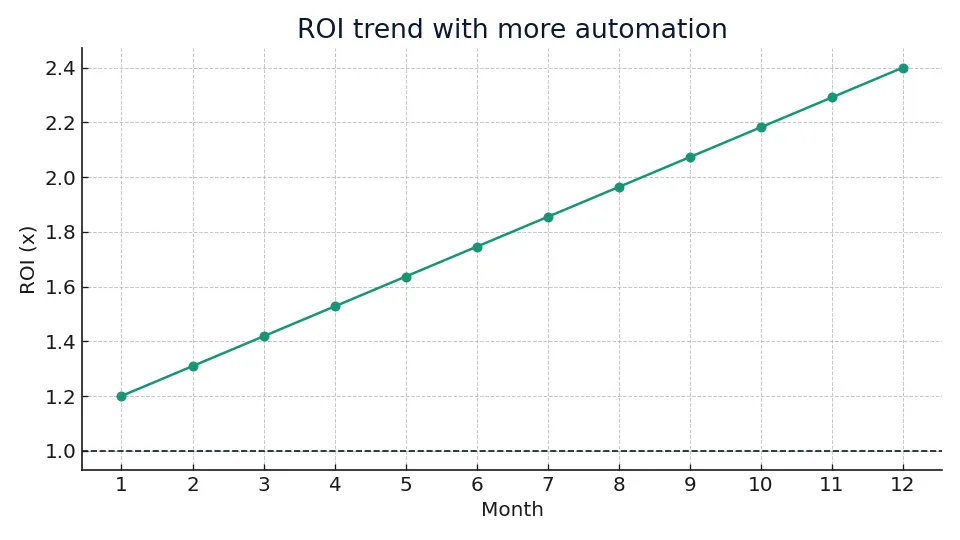
Visual #2 – ROI trend as you rebalance ads & automation
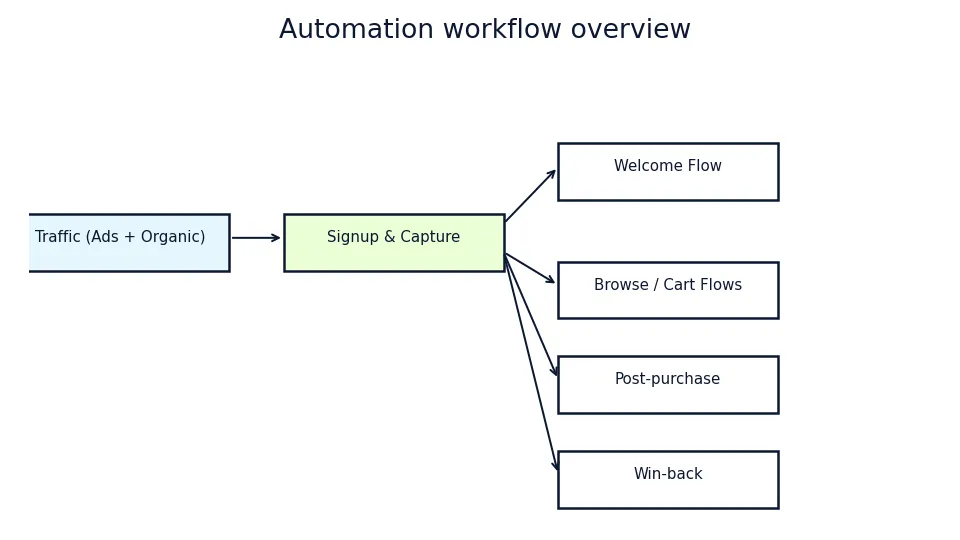
Visual #3 – Automation workflow replacing part of your ad spend
30-day blueprint to safely reduce Facebook ad dependence
You don’t need a massive replatforming project to change your trajectory. Here’s a realistic 30-day plan for a small ecommerce team using a tool like Omnisend to reduce Facebook ads dependence.
Days 1–7: Audit & foundations
- Connect your store to your email & SMS platform (e.g. Omnisend pricing & setup).
- Import existing subscribers and clean inactive contacts.
- Audit current flows and campaigns — identify gaps vs the 5 core flows.
- Document your baseline: revenue split, ad spend, email/SMS revenue.
Days 8–15: Build the core flows
- Launch a 3–4 step Welcome flow with solid storytelling and offers.
- Set up cart/checkout abandonment flows with at least two follow-ups.
- Add a basic post-purchase flow for your top 2–3 product categories.
- Turn on browse abandonment for key product collections.
If time is tight, prioritize flows based on immediate revenue impact: cart/checkout > welcome > browse > post-purchase > win-back.
Days 16–23: Add segmentation & SMS where it counts
- Segment VIPs vs one-time buyers and tweak offers accordingly.
- Add SMS to high-intent moments (cart, checkout, delivery updates).
- Use behavior-based triggers from your store (views, clicks, orders).
- Start measuring revenue per 1,000 sends by flow and segment.
This is where a dedicated ecommerce tool shines. Omnisend, for example, gives you native ecommerce triggers, dynamic product blocks and an SMS cost calculator so you can confidently layer SMS on top of email.
Days 24–30: Rebalance budgets and set new guardrails
- Compare your new automation revenue vs the baseline from Day 1.
- If automation now covers a predictable % of monthly revenue, start by cutting 5–10% of your Facebook budget and monitor total sales.
- Reinvest some saved budget into list growth (giveaways, quizzes, content).
- Repeat this cycle every 30 days until you reach a healthier balance.
The key is to treat this as a controlled experiment. The goal isn’t to kill ads; it’s to reduce Facebook ads dependence to a level where policy changes, tracking issues or CPM spikes no longer threaten your business.
How Omnisend fits into this strategy
Could you implement this framework with a generic email tool? Maybe. But if you want to move fast with limited resources, choosing a platform built specifically for ecommerce automation matters.
Omnisend gives you:
- Native integrations with Shopify, WooCommerce and other major carts.
- Pre-built ecommerce flows (welcome, cart, browse, post-purchase, win-back).
- Channel mix (email + SMS + push) in a single interface.
- Reporting focused on revenue, not vanity metrics.
That’s why the core CEM content stack is built around Omnisend as the primary recommendation. For a full overview of features and positioning, see the pillar page at our Omnisend hub.
CTA – Validate this framework with your own numbers
Theory is useful, but your numbers are all that matter. Connect your store, launch the core flows, and watch how much revenue they generate before you change any ad budgets.
From there, you can gradually reduce Facebook ads dependence with real confidence, not guesswork.
Decision & next steps: your “less ads, more profit” roadmap
Let’s synthesize everything into simple decisions you can make this week.
- If 70%+ of your revenue currently comes from Facebook/Instagram ads, your business is fragile. Prioritize building capture + automation immediately.
- If your email/SMS revenue is under 20% of total, you have huge upside from flows alone.
- If you’re already running basic flows but not optimizing them, focus on segmentation and personalization before you try more ad hacks.
The endgame is a business where owned channels generate a stable, growing share of your revenue — and ads simply amplify what already works. That’s what it really means to reduce Facebook ads dependence without sacrificing growth.
FAQs: reducing ad dependence for small ecommerce stores
Can I really cut Facebook ad spend without killing my revenue?
Yes — but not overnight and not without a plan. The safe way to reduce Facebook ads dependence is to first build a baseline of predictable revenue from automation flows. Once Welcome, cart/checkout, browse, post-purchase and win-back flows are live and generating consistent revenue, you can gradually lower ad budgets and track total sales. When done in small steps, most stores maintain or even grow revenue while spending less on ads.
How big does my list need to be before this works?
You don’t need a huge list. Even a few thousand engaged subscribers can generate meaningful revenue if your flows are set up correctly. The earlier you start, the faster every new subscriber compounds. The real shift happens when your list revenue becomes predictable enough that Facebook feels optional, not mandatory.
What if I don’t have time to build complex automations?
You don’t need a complex setup to start. Use pre-built ecommerce templates from tools like Omnisend, customize the copy, and launch. You can always refine logic and add branches later. The biggest wins usually come from a few well-structured flows, not hundreds of complicated automations.
Is email enough, or do I need SMS as well?
Email alone can carry a lot of the load, but SMS is extremely powerful in high-intent moments like cart abandonment, delivery updates and limited-time offers. A balanced mix of email + SMS helps you reduce Facebook ads dependence faster because you capture attention across more owned channels without paying for extra impressions.
How long does it take to see results from this strategy?
Most stores see meaningful changes within 30–90 days. It takes time for flows to capture enough traffic and for subscribers to move through the journeys. However, cart/checkout and browse flows can start recovering lost revenue almost immediately. As those numbers stack up, you gain confidence to reallocate budget away from Facebook.
Final verdict: build a business that survives without Facebook
Depending on any single platform for most of your revenue is a risk you can’t fully control. The good news is that you don’t need a giant team or a complex tech stack to change that. By focusing on capture, automation and optimization, you can steadily reduce Facebook ads dependence and grow a healthier, more resilient ecommerce business.
Ads will always have a place in your mix. But when owned channels do the heavy lifting, you get to decide how aggressively you advertise — instead of letting platform volatility decide for you.