
Omnisend vs ActiveCampaign for Ecommerce (Automation Depth vs Speed)
This Omnisend vs ActiveCampaign comparison is built for one thing: helping you choose the platform that will actually ship revenue flows fast—without turning your email marketing into an engineering project.
Micro-urgency (no hype): most ecommerce brands either overbuy automation or underuse it. This page prevents both.
Transparency: some links are affiliate links. That doesn’t change the recommendation—only supports testing and updates.
Verdict (for most ecommerce stores): In Omnisend vs ActiveCampaign, choose Omnisend if you want fast, ecommerce-native automations that work out of the box. Choose ActiveCampaign only if you will truly use deeper logic + CRM-style lifecycle operations.
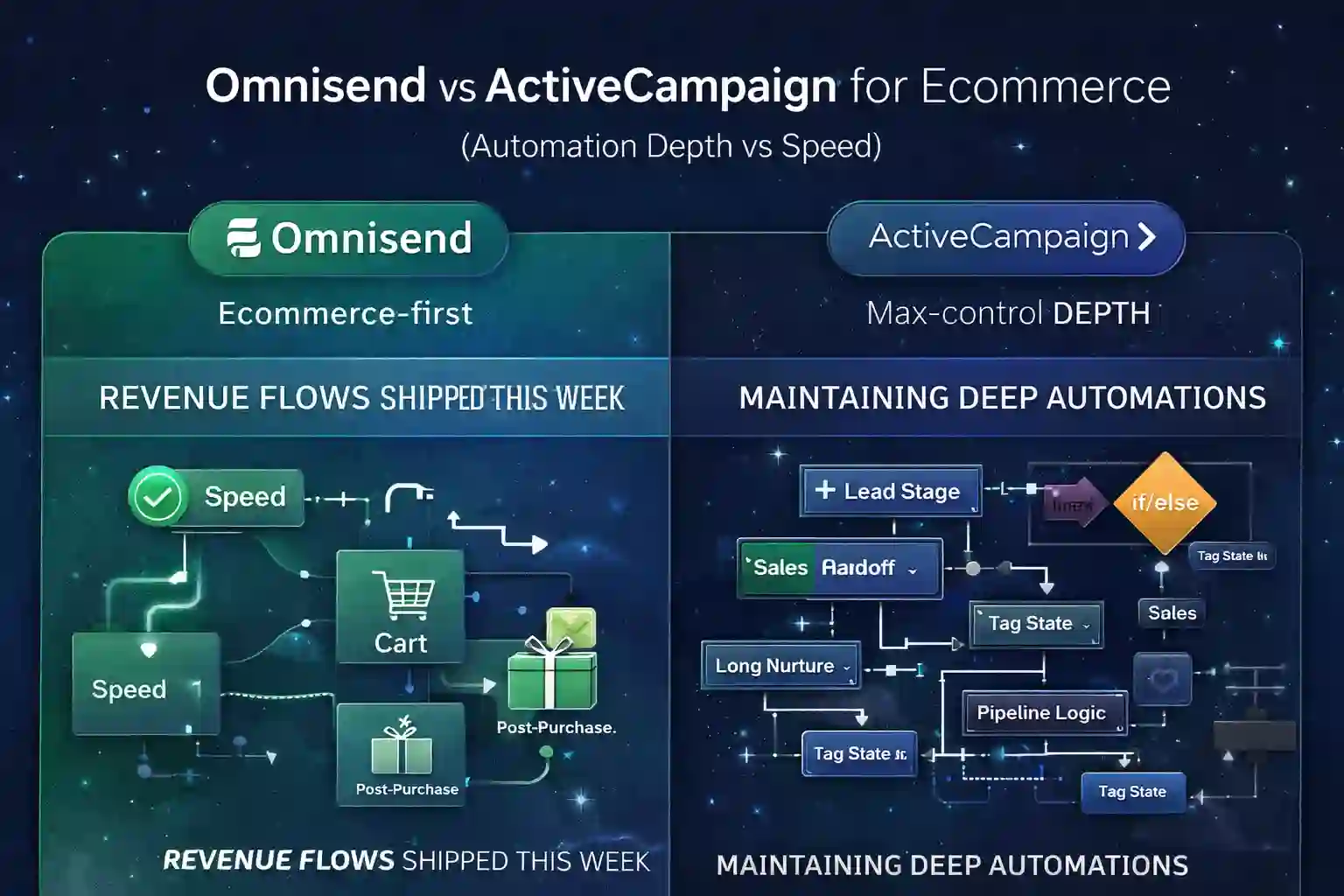
Omnisend vs ActiveCampaign: quick decision (no fluff)
If you’re choosing between Omnisend vs ActiveCampaign, you’re really choosing between ecommerce speed and automation depth. Both can send emails. Both can automate. The difference is what happens after day one: how fast you get revenue flows live, and how hard they are to maintain.
Pick Omnisend if you want to launch revenue automations quickly with minimal complexity:
- Cart abandonment, browse abandonment, post-purchase, and winback flows that don’t require “automation architecture.”
- Clear ecommerce-first segmentation and message timing without endless tag hierarchies.
- A platform your team will actually use consistently (not just admire in month one).
Pick ActiveCampaign if you genuinely need deep conditional automation + CRM-style operations:
- Your lifecycle logic is complex enough to justify building and maintaining it (not just “nice to have”).
- You run lead stages, sales handoffs, pipeline logic, and long nurture journeys that behave more like B2B operations.
- You have a team (or partner) who will document, QA, and maintain flows continuously.
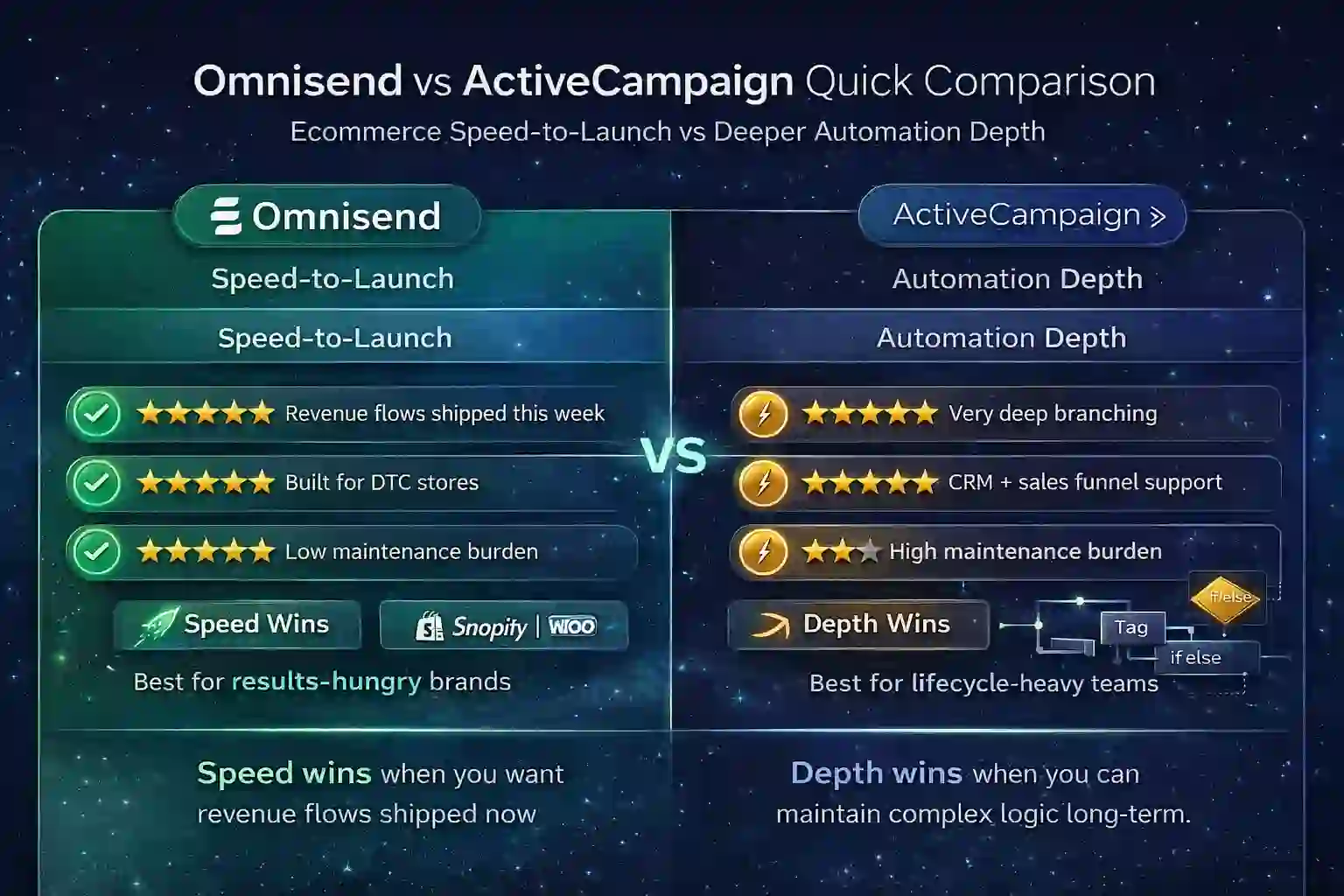
Omnisend vs ActiveCampaign comparison table (what matters at BOFU)
This Omnisend vs ActiveCampaign table is intentionally biased toward decision-critical factors: setup speed, ecommerce triggers, maintenance burden, and how likely you are to use what you pay for in real life.
| Decision factor | Omnisend | ActiveCampaign | Who this favors |
|---|---|---|---|
| Time to first revenue flow | ⭐⭐⭐⭐⭐ fast setup, ecommerce-first | ⭐⭐ deeper setup and mapping | Speed teams |
| Ecommerce-native triggers | ⭐⭐⭐⭐⭐ built around shopping behavior | ⭐⭐⭐ possible, but more custom | Stores focused on DTC |
| Automation depth (if/else logic) | ⭐⭐⭐ strong enough for most stores | ⭐⭐⭐⭐⭐ very deep branching | Ops-heavy teams |
| Maintenance burden | ⭐⭐⭐⭐⭐ low (ship + iterate) | ⭐⭐ high (tag hygiene, QA) | Lean teams |
| Best fit | Shopify/Woo stores that want results quickly | Lifecycle orchestration + CRM-style complexity | Depends on workflow |
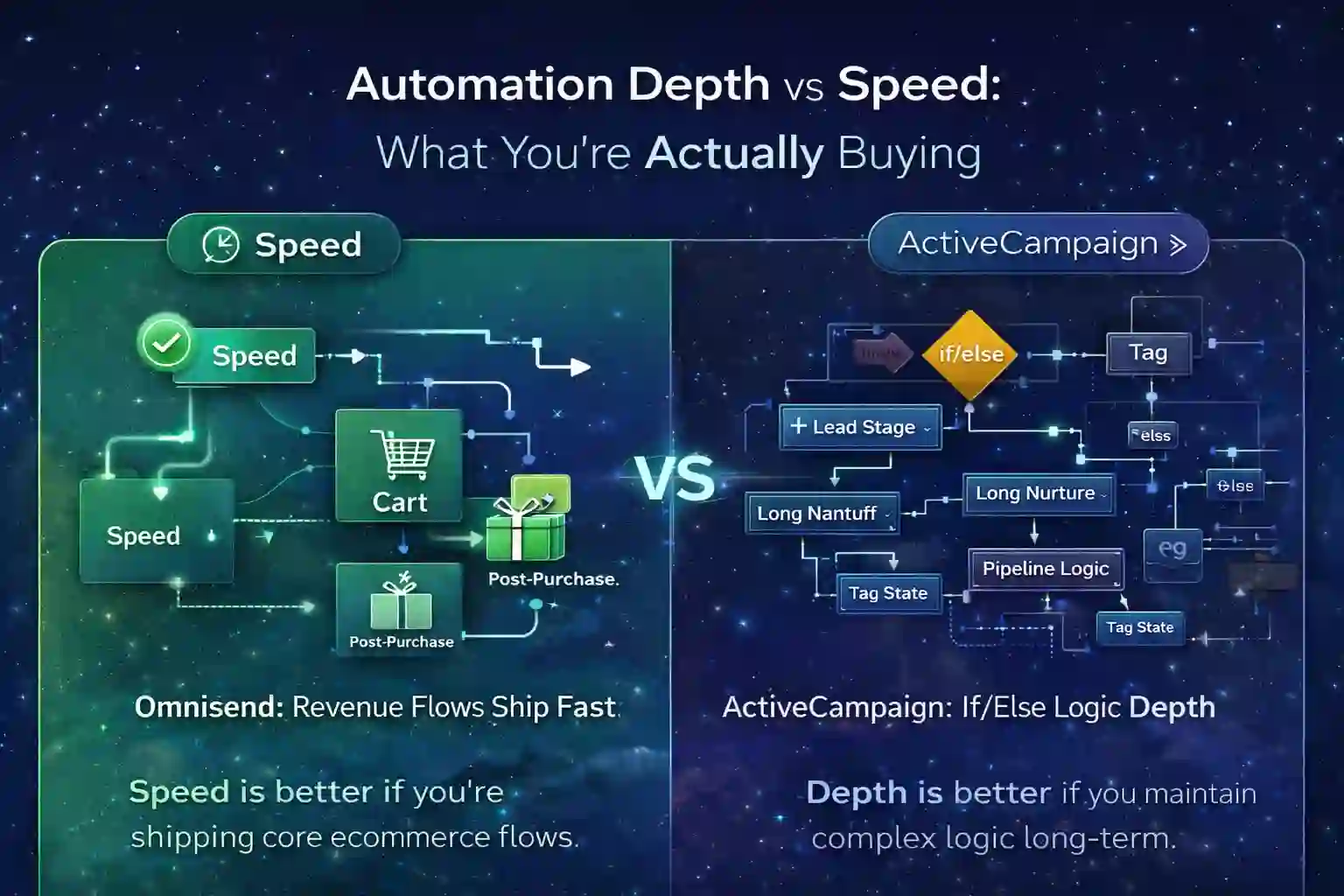
Omnisend vs ActiveCampaign: what “automation depth” really means
“Automation depth” is a vague phrase people use to justify a more complex platform. In Omnisend vs ActiveCampaign, depth means the platform can represent more logic, more states, more exceptions, and more long-running journeys. That can be brilliant… or it can be a trap if your team never maintains it.
When depth is worth paying for
ActiveCampaign makes sense when your marketing behaves like an operations system: you’re coordinating states (lead stages), handoffs (sales ↔ marketing), and decision trees that evolve over time.
When speed is the smarter buy
Ecommerce winners usually ship the same handful of flows, then optimize creative, timing, segmentation, and offers. In that world, Omnisend’s ecommerce-first approach typically wins: less setup, fewer failure points, and faster iteration.
Feature & workflow matrix (Omnisend vs ActiveCampaign)
This matrix focuses on what ecommerce teams repeatedly touch. If a feature is powerful but rarely used in practice, it does not get “extra points.”
| Workflow / capability | Omnisend | ActiveCampaign | What it means in practice |
|---|---|---|---|
| Abandonment flows (cart + browse) | Ecommerce-native | Possible | You want these live fast. Omnisend is usually quicker to deploy and iterate. |
| Post-purchase sequences | Built for repeat purchases | Customizable | Depth helps only if you maintain branching (SKUs, LTV tiers, replenishment logic) long-term. |
| Segmentation philosophy | Behavior-first | Tag/state-heavy | Tag systems can become fragile; behavior segmentation stays cleaner for lean teams. |
| Deep conditional automation | Enough for most stores | Best-in-class depth | ActiveCampaign shines when “if/else” and states are your core operating model. |
| CRM / pipeline-driven lifecycle | Not the focus | Strong fit | If you need pipelines and sales stages, AC can justify the complexity. |
| Maintenance + QA overhead | Lower | Higher | More flexibility means more ways to break things. Plan documentation and testing. |
If you want a broader shortlist beyond Omnisend vs ActiveCampaign, start here: email automation software.
Real-world scenarios (map your store to the right tool)
Scenario A: “We want revenue flows live this week.”
You run a Shopify or WooCommerce store, time is limited, and your main KPI is incremental revenue from abandonment and post-purchase. You don’t want to design a universe of tags and states. You want to ship, measure, and iterate.
Recommendation: Omnisend. In Omnisend vs ActiveCampaign, the opportunity cost of delay is usually larger than the theoretical benefit of deeper logic.
Scenario B: “We need automation as an operating system.”
You have multiple product lines, lifecycle tiers, and a sales-assisted motion—or you run a hybrid business that behaves like B2B. Your automations must reflect state transitions (qualification stages, onboarding milestones, renewal pipeline logic).
Recommendation: ActiveCampaign. Depth can be a strategic advantage if you have the people and discipline to maintain it.
Scenario C: “We tried a complex tool and it became a mess.”
If your last system suffered from tag sprawl, broken segments, or automations nobody trusts, choose the platform that reduces complexity by default. Your future self will thank you.
Recommendation: Omnisend (or at minimum, avoid building fragile tag architecture).
Pricing reality in Omnisend vs ActiveCampaign (what to watch)
Pricing is rarely just “how much per month.” It’s the combination of what you pay, what you actually use, and the time your team spends to make it work. In Omnisend vs ActiveCampaign, the hidden variable is usually team time (setup + maintenance).
Omnisend: tends to align with ecommerce execution
If you want a current breakdown and what affects cost, use our updated page: Omnisend pricing (2026).
ActiveCampaign: rewards teams who fully exploit depth
If you only end up using basic ecommerce flows, you may be paying for power you don’t touch.
Proof you can verify (official docs)
ActiveCampaign automation basics (official help) .
(Use this to confirm whether your team will realistically build and maintain deep conditional automation.)
The real cost shows up in month 2–6: broken segments, outdated tags, flows that don’t match how the store evolved, and “tribal knowledge” nobody documented.
Omnisend generally minimizes maintenance because the ecommerce model is simpler.
ActiveCampaign can create a maintenance cliff if you build a tag/state universe without rules.
A simple self-audit (60 seconds)
- Do you already maintain a clean tagging system today? If not, AC will amplify the chaos.
- Can you commit to monthly QA of segments, triggers, and journeys? If not, choose the simpler model.
- Is your “dream automation” worth ongoing maintenance? If it’s not, pick speed and ship revenue.
Billing clarity: avoid surprises as your list grows
Before you pick, make sure you understand how each platform thinks about list size, sending volume, and what triggers plan upgrades.
If pricing rules are your main concern, start here: Omnisend pricing breakdown.
Final recommendation: Omnisend vs ActiveCampaign (BOFU)
If you’re an ecommerce brand and you want automations that launch fast, stay maintainable, and drive revenue from the behaviors that matter (cart, browse, post-purchase, winback), the default winner in Omnisend vs ActiveCampaign is Omnisend.
ActiveCampaign is the better tool only when you can clearly articulate (and maintain) deeper lifecycle logic—especially when CRM-style orchestration is central to your business.
FAQ
Is Omnisend or ActiveCampaign better for Shopify?
For most Shopify stores, Omnisend is the faster and more maintainable choice because it’s built around ecommerce triggers (cart, browse, post-purchase, winback). ActiveCampaign can work, but it’s usually chosen when you need deeper lifecycle logic and have the team to maintain it.
When should an ecommerce brand choose ActiveCampaign?
Choose ActiveCampaign when your automation needs are genuinely complex: multi-stage lifecycle states, CRM/pipeline coordination, and heavy conditional logic that you will actively maintain. If your core flows are standard ecommerce revenue automations, you’ll usually get better ROI with Omnisend.
What’s the biggest hidden cost difference?
Maintenance. A deeper tool can create tag sprawl and fragile logic if there’s no system and ownership. Omnisend generally reduces ongoing overhead by keeping the ecommerce model straightforward and quicker to iterate.
Where can I compare current Omnisend pricing?
Use the updated internal breakdown here: Omnisend pricing (2026).