AI Email Automation for Ecommerce: What Works vs What’s Hype
AI email automation sounds magical — until you try to ship revenue, not vibes. This page separates what actually moves ecommerce metrics (conversion, AOV, repeat purchases) from what’s just “AI lipstick” on a newsletter tool. You’ll leave with a simple framework, a quick self-check, and a clean next step.
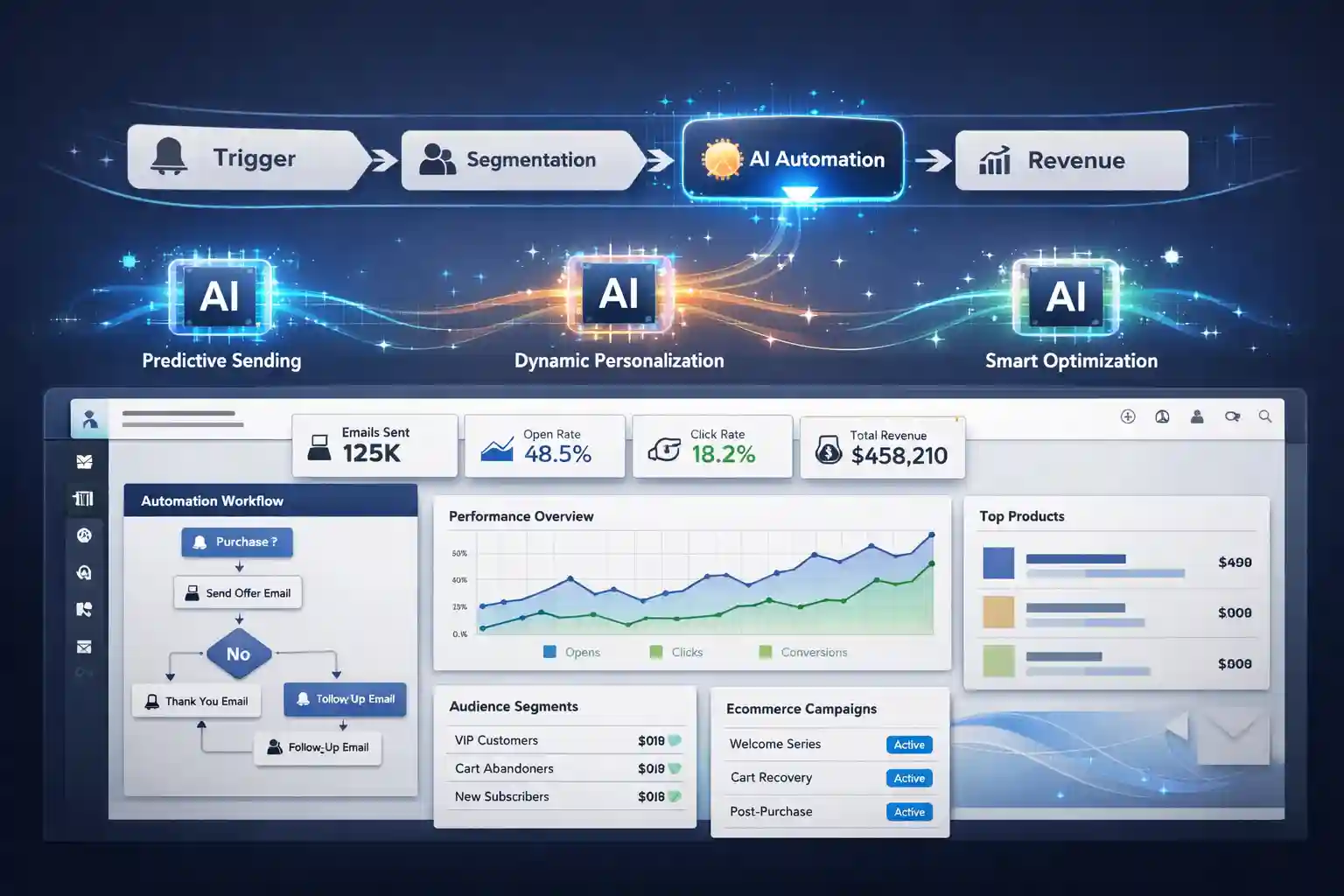
AI email automation is not a strategy — it’s an amplifier
If your flows are weak, AI email automation just helps you send weak messages faster. The win is simpler: build a clean automation backbone (events + segments + lifecycle timing), then use AI to improve parts of it (copy, product picks, send-time, segmentation speed).
Also: AI doesn’t bypass inbox rules. Authentication and unsubscribe standards are now explicit requirements for bulk sending to major inboxes — meaning your fundamentals must be correct before “AI” matters. Google’s sender guidelines is a good baseline reference (follow link).
Where people get fooled (fast)
-
“AI personalization”
But it’s just first-name + generic copy. Real personalization uses behavior + product context.
-
“AI automations”
But there are no real triggers/events. Without triggers, you’re doing newsletters with extra steps.
-
“AI will fix deliverability”
It won’t. SPF/DKIM/DMARC + unsubscribe compliance and list hygiene still decide your inbox placement.
AI email automation: what works (and what’s hype)
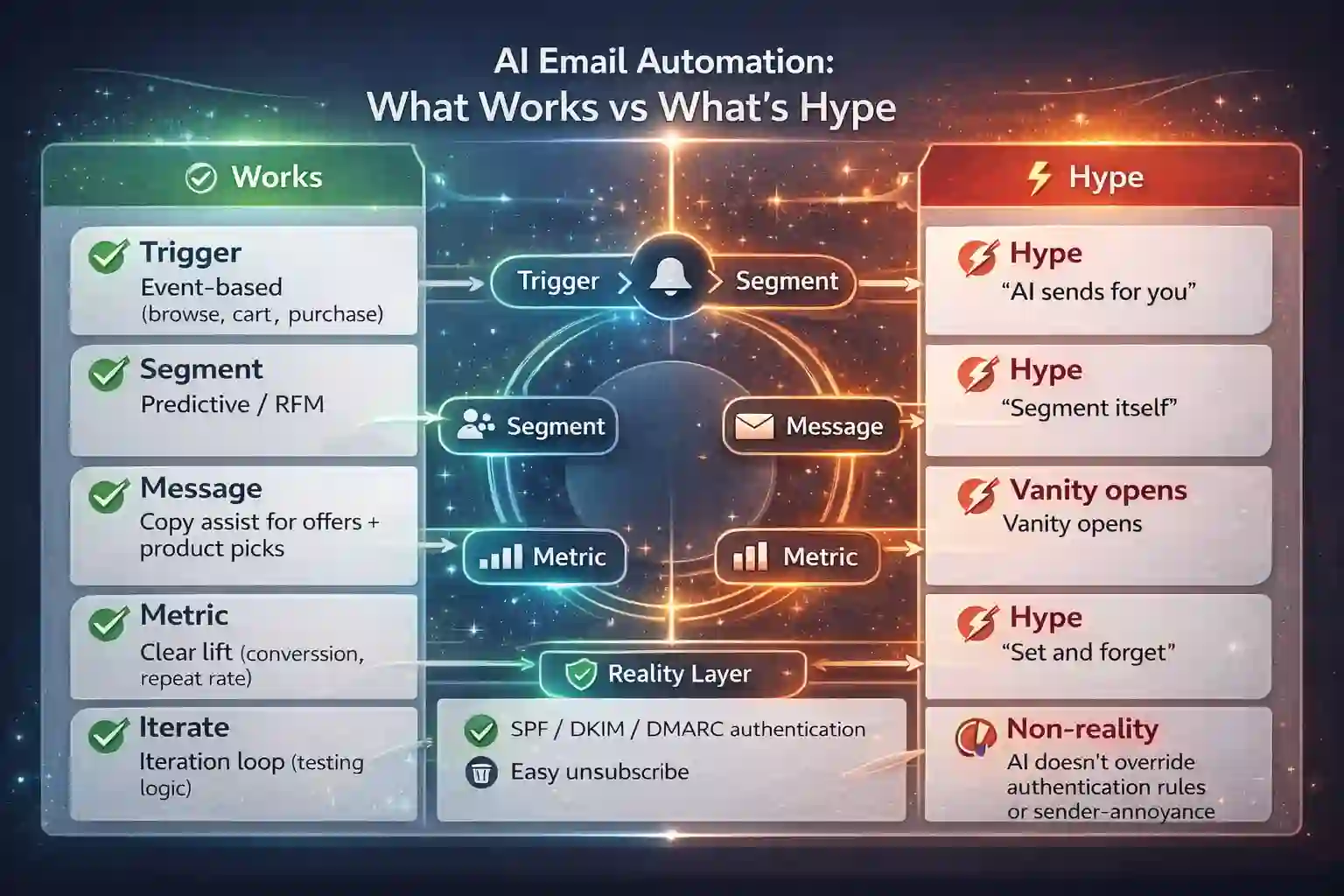
Use this simple backbone to evaluate any “AI” claim in ecommerce. If it improves one of these steps in a measurable way, it’s useful. If it’s hand-wavy, it’s hype.
1) Trigger
Browse, cart, purchase, repeat, churn risk. No trigger = no automation.
2) Segment
Behavior + value + category intent. AI helps you segment faster, not magically.
3) Message
Offer + product relevance + urgency + clarity. AI helps draft, you decide the strategy.
4) Metric
Revenue per recipient, conversion, repeat rate. AI must tie back to a KPI.
5) Iterate
Test timing, offers, product logic. AI can suggest, but you still need discipline.
Reality layer
Deliverability + consent. For bulk senders, major inboxes explicitly require authentication and easy unsubscribe.
7 ecommerce use cases where AI email automation is genuinely useful
This isn’t about “AI campaigns.” It’s about using AI to improve high-leverage flows that already have intent. The list below is intentionally practical.
-
Abandoned cart: smarter product & objection handling
AI helps pick the right alternative product, explain sizing/shipping, and reduce decision friction.
-
Browse abandonment: intent-based category nudges
When someone browses “category X”, AI can draft a relevant angle + pair with top sellers.
-
Post-purchase: cross-sell that matches the bought item
AI can draft “how to use” + recommend accessories that actually make sense.
-
Win-back: churn-risk segmentation
Predictive segments + tailored offer ladders beat “20% off to everyone”.
-
Send-time optimization (where available)
AI can help timing, but only after your content and targeting are solid.
-
Subject line & CTA iteration
Use AI for volume — then keep what improves revenue per recipient.
-
Natural-language segmentation (speed)
Less time building segments, more time shipping flows and learning.
What “hype” looks like in the wild
Most hype claims fall into the same pattern: “AI will do marketing for you.” In ecommerce, that usually means the tool is hiding missing fundamentals.
Non-negotiables (still true in 2026)
-
Authentication
Bulk sending requires SPF + DKIM + DMARC for Gmail, and Yahoo also emphasizes authentication + DMARC alignment. (AI doesn’t change this.)
-
Easy unsubscribe
One-click unsubscribe and sender best practices are explicitly called out in major inbox guidance.
-
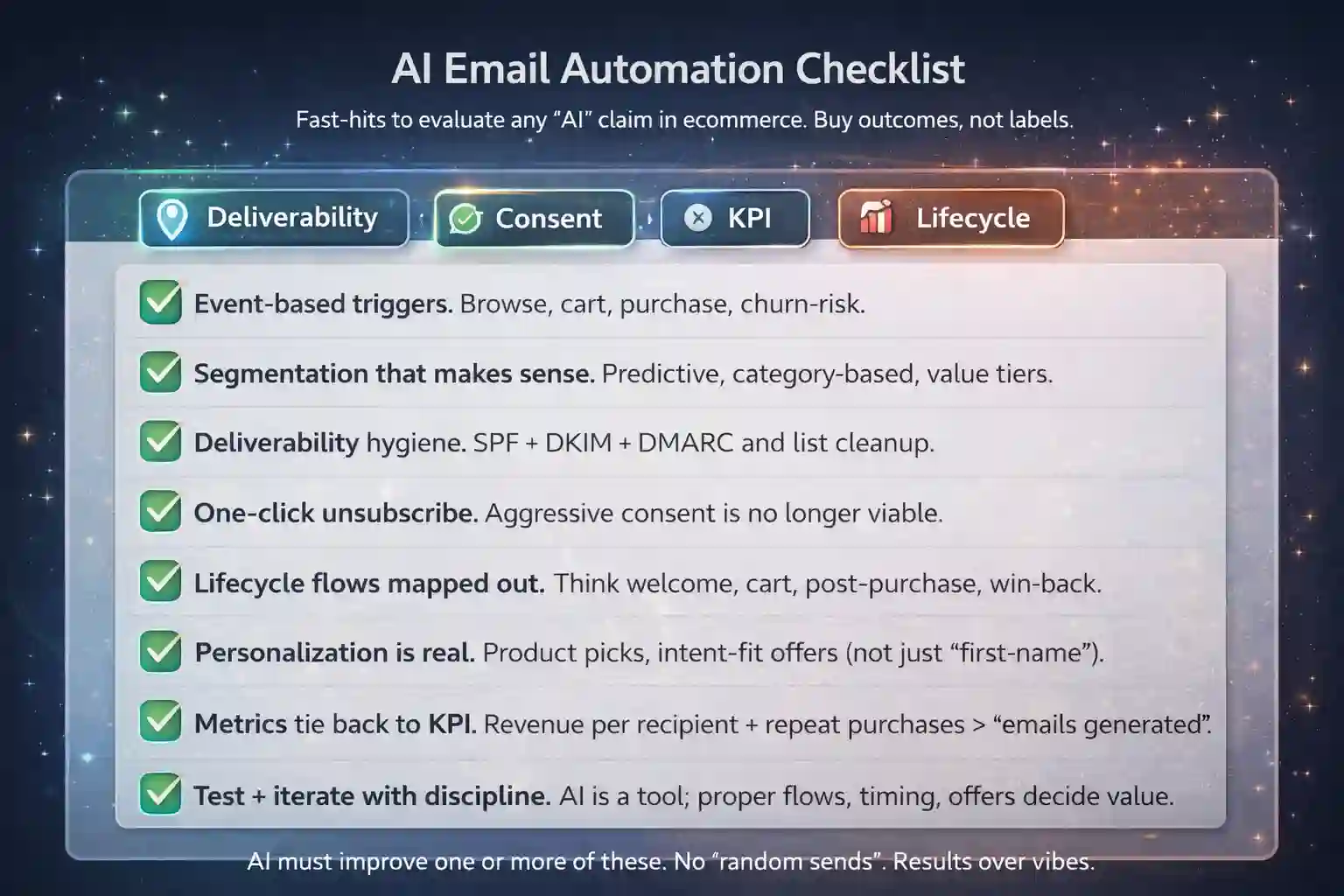
Lifecycle KPIs
Measure revenue per recipient + repeat purchase lift, not “AI emails generated”.
Quick scorer: which flows should you launch first?
Answer 5 questions. You’ll get a simple “first 14 days” recommendation. This makes AI email automation practical: launch the right flow first, then use AI to polish.
Tip: use AI for subject lines and product angles after the flow logic is correct. Don’t “AI” your way out of missing triggers.
Fast comparison: automation vs “AI automation” vs manual
The goal is not to chase labels. It’s to buy outcomes. This table makes it obvious where AI email automation helps and where it’s marketing.
| Approach | Best for | What it actually improves | Common failure |
|---|---|---|---|
| Manual campaigns Slow | Very small lists, early testing | Control, learning your audience | Inconsistent sending, no lifecycle coverage |
| Automation (baseline) Essential | Ecommerce stores with events | Timing + relevance + revenue per recipient | Weak segmentation, generic copy |
| AI email automation (layer) Amplifier | Teams who already run flows | Faster iteration: copy, product logic, segmentation speed | Used as a replacement for strategy & hygiene |
Pros & cons (honest)
AI email automation can be a real advantage — if you treat it as a layer on top of strong fundamentals.
Pros
- Speed
Draft variants fast, test more, learn faster.
- Relevance
Better product angles and intent-fit messaging (when paired with real triggers).
- Execution consistency
Less “we’ll do it later”. Flows keep printing while you sleep.
Cons
- Garbage in, garbage out
If segmentation is sloppy, AI scales the wrong message.
- Brand drift
Without guardrails, AI copy can feel “off”.
- False confidence
AI doesn’t replace deliverability, consent, or offer strategy.
Implement block (AI-Ready Omnisend)
Placeholder “implement” hub — keep it internal (LP next step). If želiš, zamenjaš linke s tvojimi AI-specifičnimi vodiči.
AI-Ready Omnisend: Next Steps
Start with the right foundation, then add AI where it improves output.
- Email Automation Software
Pick a stack that supports events, segments, and lifecycle flows.
- Marketing Automation
Map the lifecycle strategy so “AI” doesn’t become random campaigns.
- ChooseEmailMarketing.com hub
Browse the core cluster and follow the right corridor.
Trends that matter (not hype)
- Deliverability-first discipline
Inbox rules are stricter; AI doesn’t override authentication and unsubscribe requirements.
- Lifecycle metrics over vanity
Repeat rate and revenue per recipient beat “opens”.
- Natural-language workflows
Faster building, but still needs measurement and QA.
- Product relevance
Recommendations that reflect intent, not random “top sellers”.
FAQ
Does AI email automation work for small ecommerce stores?
Yes — but only if you start with 2–3 core flows (welcome, cart, post-purchase). AI helps you iterate faster once triggers and segments exist.
What’s the fastest way to tell hype from reality?
If the tool can’t explain “trigger → segment → message → metric”, it’s usually a newsletter tool with AI copy.
Will AI improve deliverability?
Not directly. Deliverability depends on authentication, consent, list hygiene, and complaint rates. AI can help improve content relevance, which can reduce complaints.
Which KPI should I track first?
Revenue per recipient for key flows + repeat purchase rate (over 30–90 days). Use opens/clicks only as diagnostics.
Should my LP push trial immediately?
Not as the main CTA. The LP should guide people to the right corridor first (internal next step), then offer trial as secondary.
Ready to make AI email automation actually profitable?
Start with the right stack and lifecycle logic — then add AI where it measurably improves speed and relevance.