SMS Marketing Automation for Ecommerce: Consent + Flows (Omnisend)
This page gives you a practical, **consent-first** blueprint for SMS marketing automation: what to collect, what to automate, and which flows to launch first—without turning your SMS channel into spam.
What this LP does (in plain English)
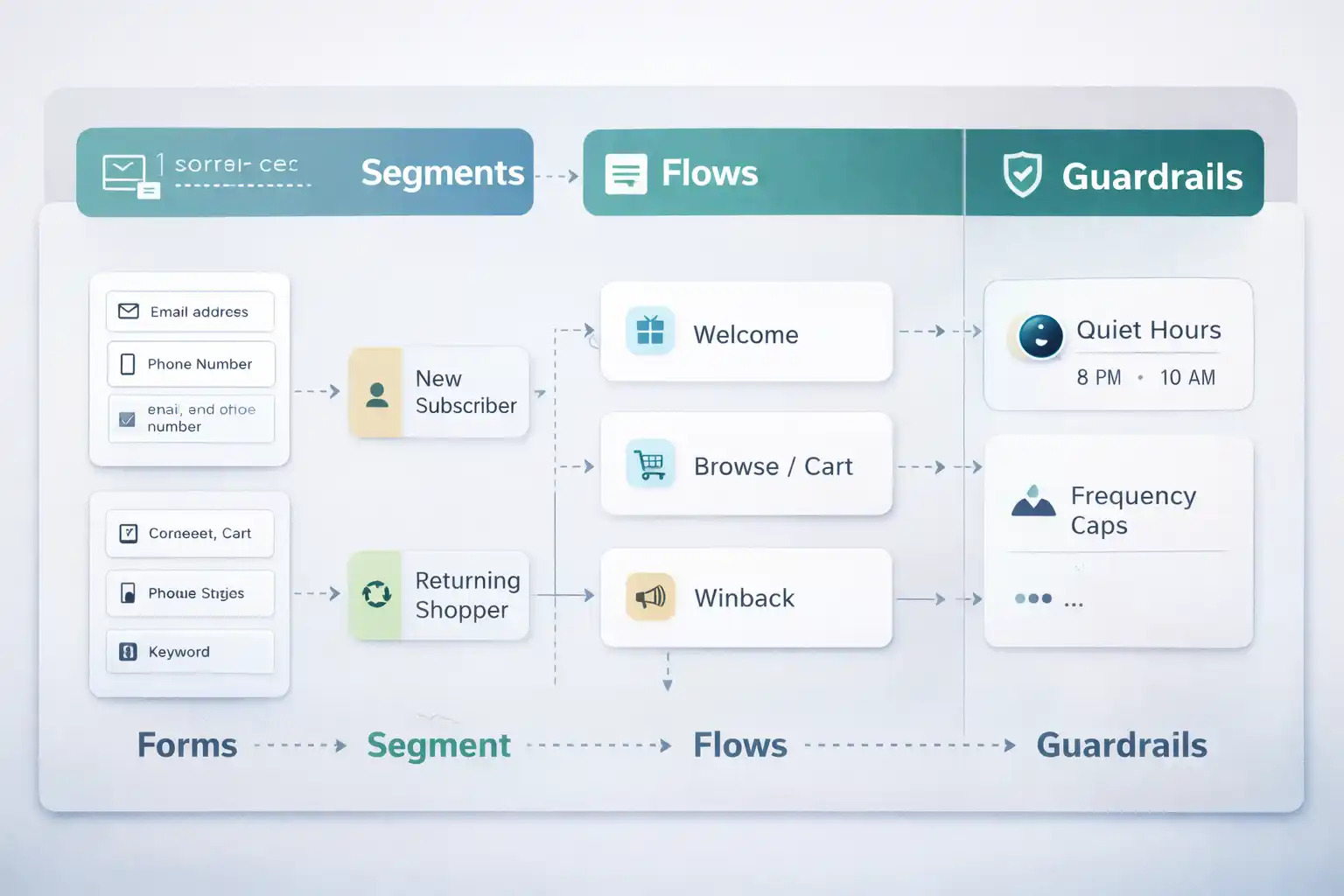
SMS is the fastest “attention” channel—but it has the tightest rules. If you treat it like email, you’ll burn trust (and list quality) quickly. This LP shows you how to build SMS marketing automation that is:
- Consent-first (clear opt-in + proof + easy opt-out)
- Flow-driven (not endless “blasts”)
- Lifecycle-aware (browse/cart/buy/repeat/winback)
- Measured (incremental revenue, not vanity clicks)
Want the full journey context? See customer journey automation. If you’re Shopify-first, jump to Shopify email automation (then add SMS as the “nudge layer”).
The “non-negotiables” (so you don’t regret SMS)
Before any flow: make opt-in language clear, store consent evidence, and keep your sending disciplined. This is not legal advice—just the practical checklist that keeps your program clean.
- Clear CTA: what they’ll receive + how often (no surprises)
- Always include opt-out instructions (e.g., STOP) and support help keywords
- Separate promotional vs transactional messaging in your planning
- Respect time zones / quiet hours and don’t over-send
- Never upload bought lists; only message opted-in contacts
- Keep a “consent trail” (source, timestamp, method) for every subscriber
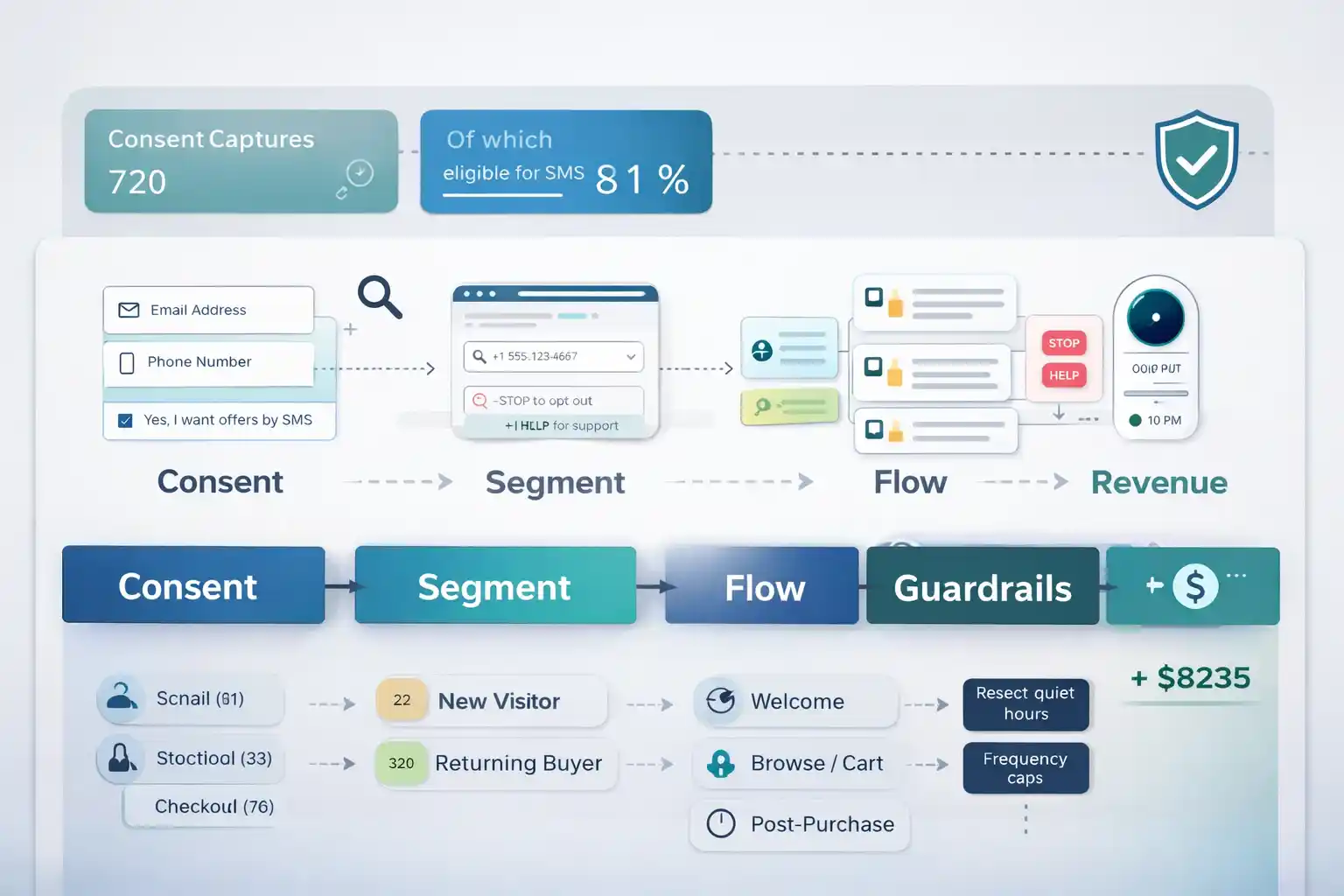
SMS marketing automation framework (Consent → Revenue)
A clean SMS program is simple. You automate the right moments, with guardrails:
Capture phone + permission in a way that’s explicit, trackable, and easy to revoke. Pair it with your email opt-in (stronger profiles, better segmentation).
Segment by intent (new vs returning), value (AOV/LTV), and stage (browse/cart/post-purchase/winback).
Use SMS as the “short nudge layer” inside lifecycle flows—not as a replacement for email.
Frequency limits, quiet hours, smart suppression (e.g., recent purchasers), and always-on opt-out.
Track incremental revenue per flow, unsubscribe rate, and complaint signals. Iterate weekly.
Core SMS flows that actually make sense for ecommerce
If you launch everything at once, you’ll over-send and under-learn. Start with a tight set of flows and scale with proof.
Welcome SMS (new subscriber)
Goal: confirm value + set expectations (frequency) + deliver first incentive (if any).
Best practice: keep it short, include opt-out info, and follow with email for details.
Abandoned checkout “nudge”
Goal: quick reminder for high-intent carts (do not spam browsers).
Guardrail: cap sends and suppress if they purchased in last X days.
Order updates (transactional layer)
Goal: reduce “Where is my order?” support load and raise trust.
Tip: keep promotional content separate from transactional updates.
Post-purchase review / UGC request
Goal: collect social proof at peak satisfaction (timing matters).
Tip: target best-fit products and recent buyers only.
Back-in-stock / price drop alerts
Goal: convert high-intent shoppers instantly.
Best practice: send only to people who explicitly requested the alert.
Winback SMS (the “last gentle nudge”)
Goal: bring lapsed buyers back without discount addiction.
If you want a proven sequence, use the internal template: winback flow.
UAU moment: SMS Readiness Score (60 seconds)
Check what you already have. The score tells you what to launch first and what to fix before scaling.
Recommended first move: Start with the SMS setup checklist.
What “good” looks like
High-performing SMS marketing automation is boring on purpose: strict consent, tight flows, and measured iteration. Your goal is: more repeat purchases with fewer messages.
Pro tip: use email for explanations, SMS for nudges. That mix usually wins on both revenue and unsubscribes.
Quick comparison: automation vs “random blasting”
| Approach | What it looks like | Result |
|---|---|---|
| SMS marketing automation | Consent-first + segmented lifecycle flows + caps | Higher repeat revenue with fewer sends (and fewer unsubscribes) |
| Broadcast-only SMS | Frequent promos to everyone | Short-term spikes, long-term trust loss + list decay |
| Email-only | Good for education + detail, weak for instant nudges | Stable, but you miss “high-intent moments” |
| Manual SMS | No segmentation, no safeguards, inconsistent | Hard to scale, high risk of over-sending |
Pros
- Fast feedback loop (minutes, not days)
- Great for high-intent moments (cart, back-in-stock, winback)
- Simple copy, simple offers, measurable impact
- Works best as a layer on top of email automation
Cons (real ones)
- Consent discipline required (you can’t “wing it”)
- Over-sending punishes you fast (unsubs/complaints)
- Needs segmentation to avoid irrelevant messages
- Short format means you must be clear + intentional
Trends that matter in 2026 (for ecommerce SMS)
- Consent evidence becomes part of deliverability “trust”
- Lifecycle-first beats promo-first (fewer messages, more profit)
- Preference centers reduce unsubscribes (topics + frequency)
- Quiet hours + time zones become standard hygiene
- SMS + email pairing becomes the default winning strategy
- Winback shifts from “discounts” to “value reminders”
Implement SMS in Omnisend (fast path)
If you want the “do-this-next” path, start here (internal, step-by-step):
FAQ
Do I need double opt-in for SMS?
Many brands use a “confirmed opt-in” step (e.g., reply YES) to strengthen list quality and proof of permission. For email subscriptions, double opt-in is a common best practice—especially in EU contexts.
How many SMS messages per week is “too many”?
There’s no universal number—what matters is expectations, relevance, and frequency control. If unsubscribes spike, you’re over-sending or under-segmenting.
Should I use SMS for discounts only?
Not if you want long-term profit. Use SMS for high-intent moments (cart, back-in-stock, winback) and pair it with email for education and product context.
What’s the best first SMS flow for a new store?
Start with Welcome SMS + a single high-intent cart nudge. Then add winback once you have purchase history.
How do I keep SMS from annoying customers?
Use clear opt-in language, quiet hours, frequency caps, and segmentation (new vs returning, high intent vs low intent). Measure unsubscribes per flow and tighten rules fast.
Ready to launch clean SMS that converts?
Start with the consent-first setup, then ship one flow at a time (Welcome → Cart → Winback). That’s how SMS marketing automation stays profitable—and sustainable.