Customer Journey Automation for Ecommerce: Lifecycle Flows in Omnisend
Customer journey automation is how ecommerce stores turn “one-time buyers” into repeat customers— using lifecycle flows (Welcome → Browse/Cart → Post-Purchase → Winback) instead of random campaigns. This hub gives you a simple framework, a launch plan, and the exact Omnisend templates to start with.
What customer journey automation means (for ecommerce)
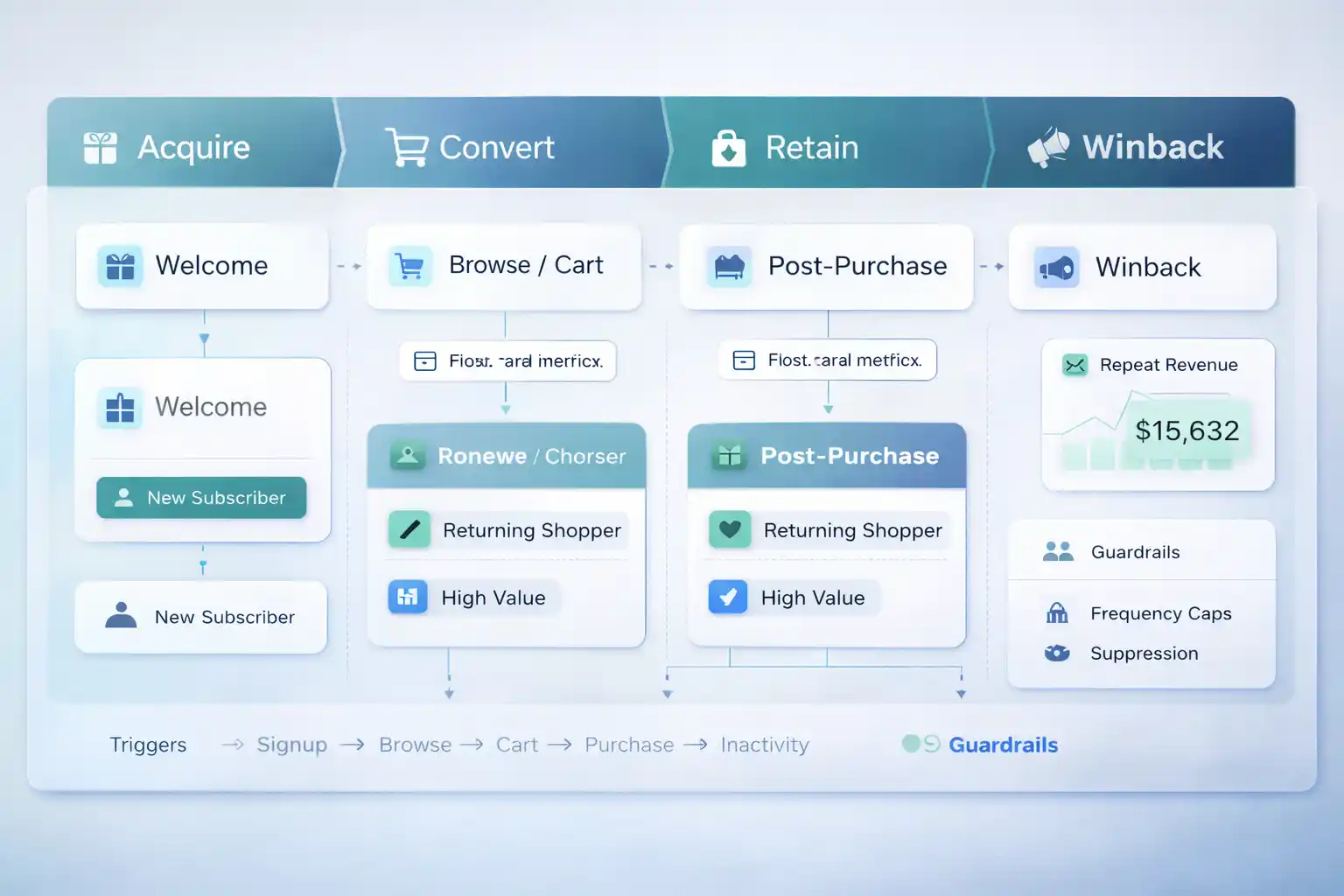
In ecommerce, customer journey automation isn’t “more emails.” It’s a repeatable system: the right message, to the right segment, at the right lifecycle moment—so revenue grows without adding daily manual work.
- Acquire: Welcome flows that convert subscribers into first buyers
- Convert: Browse/Cart nudges for high-intent sessions
- Retain: Post-purchase flows that drive the second order
- Winback: Smart reactivation for lapsed buyers
Broader context: marketing automation (wide hub). If you need B2B-style nurturing logic adapted to ecommerce, see lead nurturing automation.
The “framework” you’ll reuse on every store
This is the backbone behind profitable lifecycle programs (and it keeps the page from turning into random tips):
- Trigger: signup, browse, cart, purchase, inactivity
- Segment: new vs returning, high-value, product interest
- Message: short, clear, one job per step
- Metric: placed order, repeat rate, time-to-2nd purchase
- Iterate: tighten timing, reduce noise, improve relevance
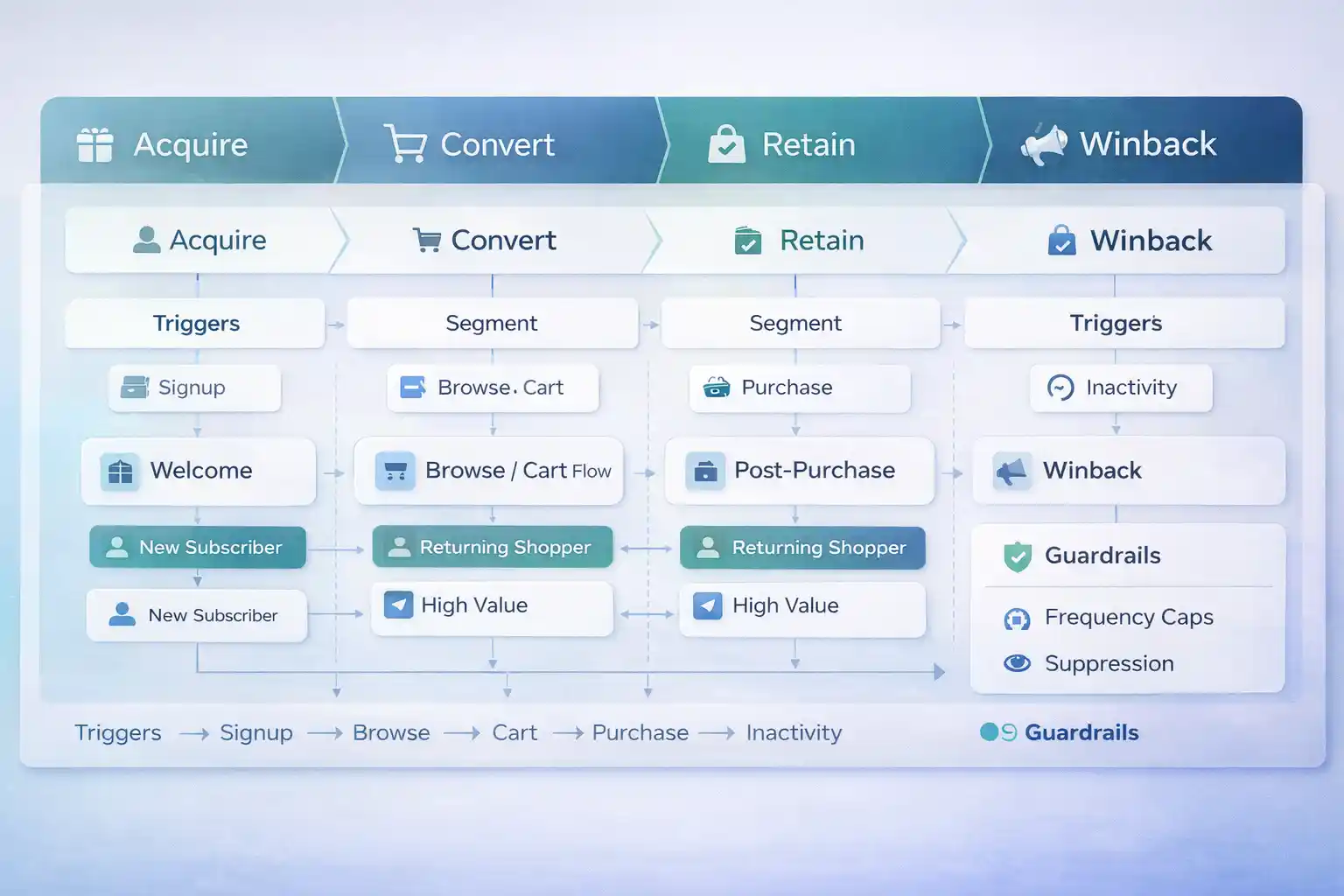
Customer journey automation map (acquire → retain → winback)
The lifecycle is not linear—people bounce between stages. Your job is to automate the “most common next step” and keep the program disciplined (few flows, high intent, measurable lift).
If you want the general concept of journey mapping (for UX and touchpoints), here’s an external reference: Shopify: customer journey map guide.
Lifecycle flows that matter most (phase by phase)
Welcome series is where you “turn attention into first purchase.” Keep it short, product-driven, and segment by intent.
Start here: Omnisend welcome series template
Browse/cart flows are not “spam reminders.” They’re relevance filters: only trigger for high-intent actions and suppress after purchase.
Rule: one job per message (return to cart, answer doubt, or show social proof).
Post-purchase is where customer journey automation becomes profitable: education, usage tips, review requests, and a smart second-order push.
Template: Omnisend post-purchase flow
Winback is a timing game. Don’t “discount instantly.” Start with value reminders and only then consider an incentive—based on margin.
Template: Omnisend winback flow
UAU moment: Lifecycle Flow Launch Planner (pick your first 2 flows)
Answer 3 quick inputs. You’ll get a recommended “start order” (so customer journey automation stays tight, not noisy).
How to keep it profitable (not annoying)
- Cap frequency (flow discipline beats “more sends”).
- Suppress recent purchasers from promo nudges.
- Segment by intent (browsers ≠ cart abandoners).
- Measure: time-to-2nd purchase + repeat revenue, not opens.
This is why customer journey automation works: it’s relevance + timing, not volume.
Quick comparison: lifecycle automation vs “campaign-only”
| Approach | What it looks like | Typical outcome |
|---|---|---|
| Customer journey automation | Lifecycle flows + segmentation + timing rules | More repeat revenue with fewer manual campaigns |
| Campaign-only marketing | Promos to everyone, ad-hoc sends | Spiky revenue, list fatigue, harder to scale |
| Manual follow-ups | “Remember to send…” workflows, inconsistent | Works at small scale, breaks with growth |
Pros
- Predictable growth path (acquire → retain → winback)
- Less manual work as the store scales
- Better relevance through segmentation
- Improves repeat purchase rate (core ecommerce lever)
Cons (real ones)
- Needs discipline (too many flows = noise)
- Requires clean events + data (browse/cart/purchase)
- Iteration is required (timing and suppression = profit)
- Consent + deliverability hygiene matters in EU
Trends that matter in 2026 for customer journey automation
- Profit metrics: repeat revenue and contribution margin matter more than opens
- Preference signals: zero-party data improves segmentation quality
- Omnichannel timing: email + SMS used as layers (not duplicates)
- Suppression logic: fewer messages, more relevance
- Lifecycle reporting: acquisition → retention views (tie flows to stages)
- Template-first execution: launch fast, then optimize
Implement Customer Journey in Omnisend (fast path)
If you want the “do-this-next” path, start with these three building blocks:
FAQ
What is customer journey automation in ecommerce?
It’s a lifecycle system that automatically guides shoppers from first touch to repeat purchase using segmented flows (welcome, browse/cart, post-purchase, winback) tied to real customer behavior.
Which two flows should I launch first?
For most stores: Welcome Series + Post-Purchase. Add Winback once you have enough purchase history. If browsing is heavy, add a high-intent Browse/Cart flow early.
How do I avoid over-messaging customers?
Use suppression rules (recent purchasers), frequency caps, and segmentation by intent. Customer journey automation works best when it’s disciplined—fewer, smarter flows.
Does Omnisend support lifecycle automation for ecommerce?
Yes—Omnisend supports event-based flows, segmentation, and automation templates. Start with the welcome series template and expand into post-purchase and winback.
What should I measure to know it’s working?
Prioritize repeat revenue, time-to-2nd purchase, and incremental revenue per flow. Opens are secondary.
Want to build your lifecycle system in Omnisend?
Start free, then implement the journey in order: Welcome → Post-Purchase → Winback. That’s the simplest way to make customer journey automation profitable.