
Updated: 27.10.2025 · Reading time: ~22–26 min
If you run a Shopify or WooCommerce store—or a small service/creator business—you likely need a platform that ships revenue automations fast, scales cleanly as you grow, and doesn’t trap you in a month-long setup. This guide compares ActiveCampaign vs Omnisend 2025 on what matters at decision time: pricing by contacts, template speed, deliverability, and the automation results small teams can expect. You’ll see a practical rollout order, a Quick Comparison, and a deep Features Matrix to decide with confidence.
Mission for small teams: ship the few flows that drive most of your revenue—fast. Complexity should follow revenue, not precede it.
TL;DR verdict
- Go Omnisend if you’re a lean ecommerce team that wants ready-to-run templates (welcome, cart, post-purchase, win-back) and speed-to-value on Shopify/Woo. It’s built to drive revenue with minimal ops friction.
- Go ActiveCampaign if you’re a small business that will actually use deeper CRM-like automations, advanced conditions, and multi-channel sequences beyond core ecommerce triggers.
- Pricing: both charge by contacts; tier inclusions differ. Validate live prices before purchase (pricing pages change). For typical ecommerce-focused stacks, Omnisend often offers more ecommerce-specific value “out of the box.”
- Deliverability: no platform can guarantee inboxing—your domain setup, list hygiene, and engagement drive results. Both provide guidance/tools; discipline beats any badge.
Validate revenue in weeks, not months. No dev team required — ready ecommerce flows.
Takes minutes to connect Shopify/Woo. Cancel anytime.
Pricing pages change often — confirm live before you decide.
Pricing: what you’ll actually pay as you grow
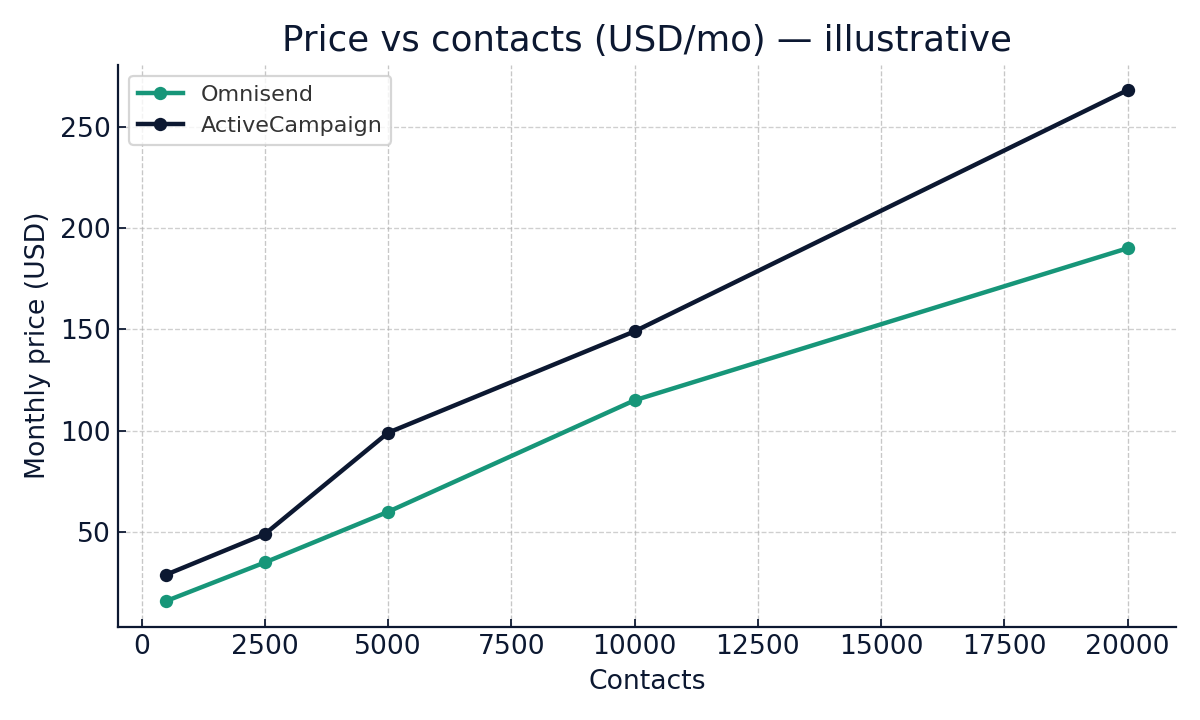
Both platforms price primarily by contacts, with features gated by plan. What matters is not just today’s tier—but the next two milestones on your growth path (e.g., 2.5k → 5k → 10k). For ecommerce-first teams, you want enough automation depth to avoid re-platforming mid-season, but not so much complexity that you delay revenue.
Budget signals (illustrative, rounded): Omnisend’s ecommerce focus means you can deploy core flows without bolt-ons; ActiveCampaign’s strength is breadth and branching depth across use cases (ecom + non-ecom). Expect Omnisend to be straightforward on templates and store triggers, and ActiveCampaign to reward you if you actually use advanced logic and multi-channel sequences.
Validate revenue in weeks, not months. No dev team required — ready ecommerce flows.
Takes minutes to connect Shopify/Woo. Cancel anytime.
Quick comparison: setup speed & common flows
Small teams win by shipping the top 3–4 flows first. Here’s a practical overview:
| Capability | Omnisend | ActiveCampaign |
|---|---|---|
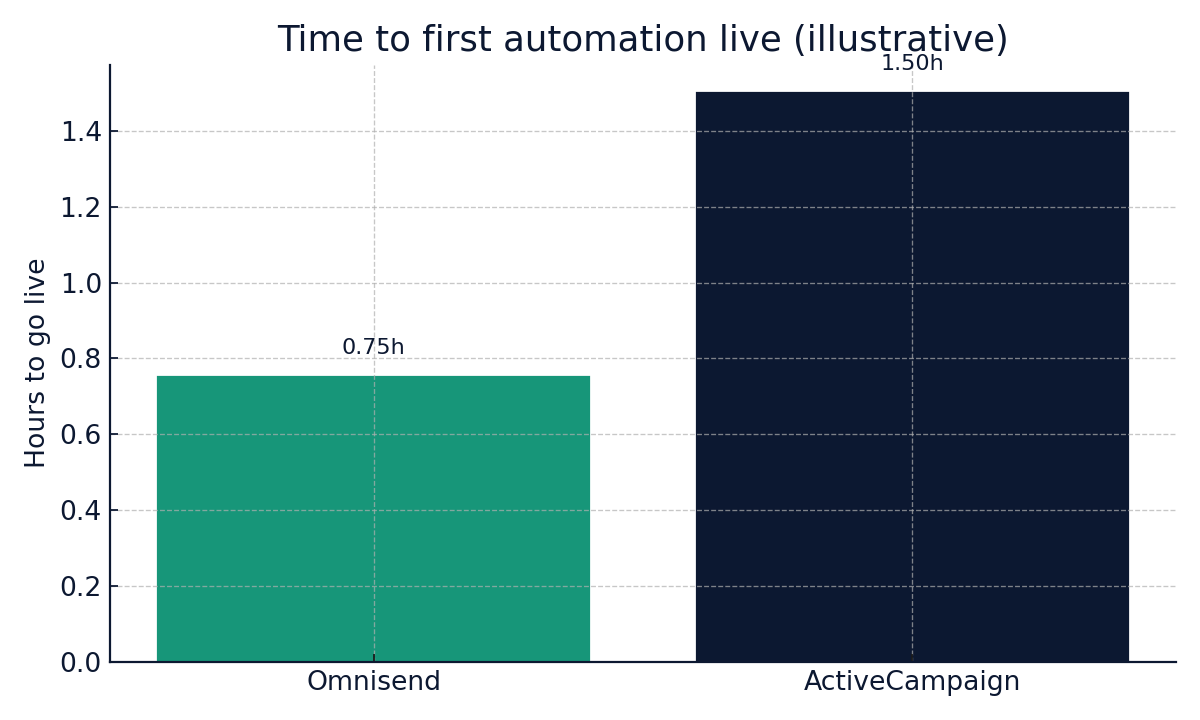
| Starter setup time (first flow) | < 1–2 hours (typical) | ~ 1.5–3 hours (typical) |
| Welcome series templates | ✓ optimized for ecommerce | ✓ flexible editor |
| Abandoned cart & dynamic items | ✓ native + SMS option | ✓ via ecom events |
| Post-purchase (education → review → cross-sell) | ✓ | ✓ |
| Win-back (60/90 days) | ✓ | ✓ |
| Browse/product view triggers | ✓ | ✓ setup complexity |
| Multi-channel (email + SMS) | ✓ built-in SMS | ✓ integrations vary |
| Editor learning curve | low | moderate |
| Best fit | store-first teams | data/branching-heavy users |
| Time to first revenue | fast (templates) | fast if prebuilt + discipline |
Automation templates & workflow depth
Omnisend is opinionated for ecommerce: you get pre-built best-practice flows (welcome, cart, post-purchase, win-back) with email + SMS options. You can be live in an afternoon. ActiveCampaign offers powerful branching, scoring, and CRM-like logic—excellent if you’ll truly use it. Otherwise, the extra flexibility can slow a small team’s time-to-value.
Need deeper branching and CRM-like automations?
Great for advanced logic if your team will actively use it.
Features Matrix (24 rows)
✓ is green; ✗ is red; if a ✓ has a limitation, the descriptor is red.
| Feature | Omnisend | ActiveCampaign |
|---|---|---|
| Welcome series templates | ✓ ecommerce-first | ✓ flexible editor |
| Abandoned cart (multi-step) | ✓ + SMS | ✓ via ecom events |
| Post-purchase education & review | ✓ | ✓ |
| Win-back (60/90-day) | ✓ | ✓ |
| Browse/product view triggers | ✓ | ✓ more setup |
| Drag-and-drop workflow editor | ✓ streamlined | ✓ powerful |
| Multiple triggers per workflow | ✓ | ✓ complexity |
| Conditional branching depth | ✓ pragmatic | ✓ granular |
| Product recommendations | ✓ ecommerce-focused | ✓ configurable |
| A/B testing in automations | ✓ | ✓ more variants |
| Send time controls & delays | ✓ | ✓ |
| Email + SMS orchestration | ✓ built-in SMS | ✓ via add-ons |
| Behavioral segments (click/view/buy) | ✓ | ✓ richer options |
| Custom fields & merge tags | ✓ | ✓ |
| Webhooks / API coverage | ✓ | ✓ broader |
| Deliverability setup guides (SPF/DKIM/DMARC) | ✓ | ✓ |
| Analytics depth & dashboards | ✓ ecom-focused | ✓ more granular |
| Attribution clarity (UTM, last-touch) | ✓ simple | ✓ advanced |
| Seats / users | varies by tier | varies by tier |
| Permissions & roles | ✓ basic | ✓ granular |
| SSO / advanced security | ✗ | ✓ |
| Landing pages / builder | built-in | via integrations |
| Community & partners | large | very large |
Deliverability: discipline beats hype
Inbox placement is less about vendor logos and more about your domain authentication, list hygiene, and engagement-based sending. Both platforms provide the essentials: SPF/DKIM/DMARC guidance, suppression tools, and segmentation. What moves the needle:
- Aligned sending domain: authenticate and align brand links; set DMARC with a monitoring policy before enforcement.
- Segment by engagement: exclude unengaged; lower daily send caps; protect your sender reputation.
- Cadence and clarity: predictable scheduling, clear expectations, and human-sounding copy win.
ROI & payback: example math for small teams
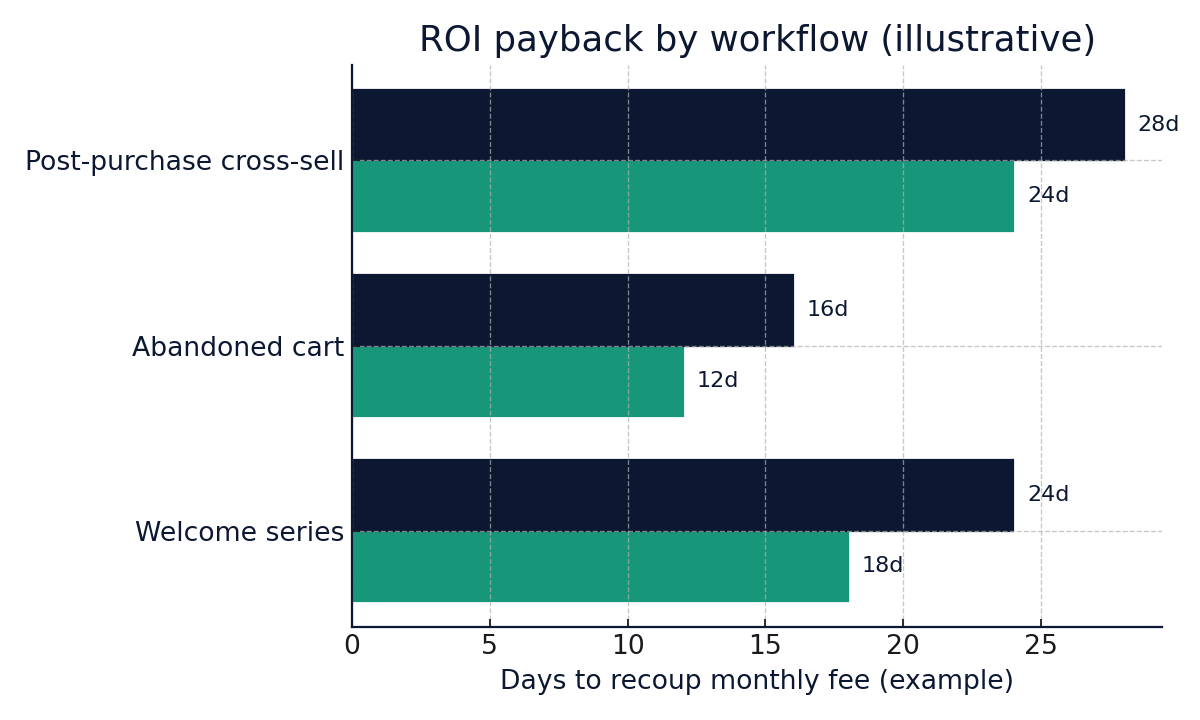
Assume 10k contacts and the three evergreen ecommerce flows. Conservative lifts often cover the monthly plan quickly—especially if you use smart timing (e.g., reminder → proof → small, rare incentive). The compounding comes from “always-on” automations that run while you focus on product and ads.
Fast rollout (60–180 minutes)
- Connect store + verify domain (SPF/DKIM/DMARC). This is your deliverability foundation.
- Load templates (welcome, cart, post-purchase). Keep copy direct; match brand visuals; add 1-click preference where useful.
- Segments: engaged 90-day, high-AOV buyers, recent buyers, lapse risk 60/90-day.
- QA: triggers, coupon integrity, mobile previews, time zones, product feed mapping.
- Launch v1 now. Add a simple A/B on subject lines and adjust delays weekly. Scale incentives only if recovery stalls.
Validate revenue in weeks, not months. No dev team required — ready ecommerce flows.
Takes minutes to connect Shopify/Woo. Cancel anytime.
Need granular branching and CRM-style logic across channels?
Best when your team will actively use advanced logic.
FAQ
Which is cheaper? It depends on tier and contacts. For ecommerce-focused stacks, Omnisend often delivers strong value per dollar with built-in store flows; ActiveCampaign’s cost pays off when you leverage deeper logic and multi-channel orchestration.
Which ships faster? Omnisend’s templates usually win time-to-value for small store teams. ActiveCampaign can be just as fast if you import prebuilt recipes and limit branching at v1.
Is deliverability better on one platform? Both are capable. Your authentication, list quality, and engagement policy determine inboxing far more than the logo on your footer.
Can I start on one and switch later? Yes. Start where setup speed is highest for your team; re-platform when complexity needs justify it.
References
- Official pricing & plan details: Omnisend, ActiveCampaign (verify live before purchase).
- Automation templates & docs: both vendors’ help centers and feature pages.
- Deliverability best practices: vendor guides + Gmail Postmaster Tools and industry benchmarks.
Final verdict
Choose Omnisend if you want ecommerce-ready revenue flows with minimal setup and built-in SMS options. You’ll ship faster and iterate weekly. Choose ActiveCampaign if you need advanced branching and CRM-like orchestration—and you have the discipline to implement and maintain it. For many small Shopify/Woo teams, Omnisend is the higher-ROI starting point; graduate into deeper logic only when your data and process justify the overhead.
Next reads:
Omnisend Pricing (2025) ·
ActiveCampaign Vs Omnisend ·
All about ActiveCampaign: here