
If you’re choosing between MailerLite and Omnisend, you likely want clear pricing, fast setup, and automations that actually sell. This BOFU guide shows real costs by list size, what each plan includes, and when to choose each. The goal is simple: help you decide today and launch revenue flows in minutes.
If you’re running a small Shopify or WooCommerce store, or you’re a creator finally taking email seriously, you probably don’t have weeks to test tools. You just want something that:
- is easy enough to launch your first automations this week,
- won’t surprise you with SMS or contact-based overages,
- can grow with you when basic newsletters aren’t enough.
This guide compares MailerLite vs Omnisend 2026 through a beginner lens — but with ecommerce-grade numbers: real pricing, list size scenarios, and ROI examples based on the latest 2026 pricing updates for both tools. :contentReference[oaicite:0]{index=0}
Pricing pages change often — confirm live before you decide.
TL;DR — MailerLite vs Omnisend for beginners
If you only read one section, make it this one.
- Fastest to launch simple newsletters & landing pages: MailerLite (clean UI, generous free plan for up to 500 subscribers after the 2026 update). :contentReference[oaicite:1]{index=1}
- Best beginner-friendly choice for ecommerce (Shopify/Woo): Omnisend — prebuilt ecommerce workflows, on-site forms, and native SMS built into the same automation builder. :contentReference[oaicite:2]{index=2}
- Cheapest starting price at 500 contacts: MailerLite Growing Business (~$10/mo) vs Omnisend Standard (~$16/mo at list price, sometimes discounted to ~$11.20 for first months). :contentReference[oaicite:3]{index=3}
- Stronger SMS & omnichannel out of the box: Omnisend Pro includes monthly SMS credits equal to your plan price and global SMS coverage; MailerLite needs external tools or MailerSend to do full SMS campaigns. :contentReference[oaicite:4]{index=4}
- Best if you’re a blogger, creator or coach: MailerLite — unlimited landing pages, simple automations, and website builder on affordable tiers. :contentReference[oaicite:5]{index=5}
- Best if you’re an ecommerce brand with growth goals: Omnisend — more robust ecommerce segmentation, proven deliverability, and ready-made revenue flows (welcome, abandoned cart, post-purchase, win-back). :contentReference[oaicite:6]{index=6}
Short answer:
- Choose MailerLite if you’re a creator / small list beginner who mainly needs newsletters + landing pages on a tight budget.
- Choose Omnisend if you’re a Shopify/Woo store and want plug-and-play ecommerce automations, SMS and better long-term ROI on email-driven revenue.
Validate revenue in weeks, not months.
No dev team required — ready ecommerce flows.
Takes minutes to connect Shopify/Woo. Cancel anytime.
Prefer a simpler newsletter & landing page builder?
Ideal for creators and small lists that don’t need deep ecommerce flows yet.
Start with MailerLite’s free plan and upgrade only when your list grows.
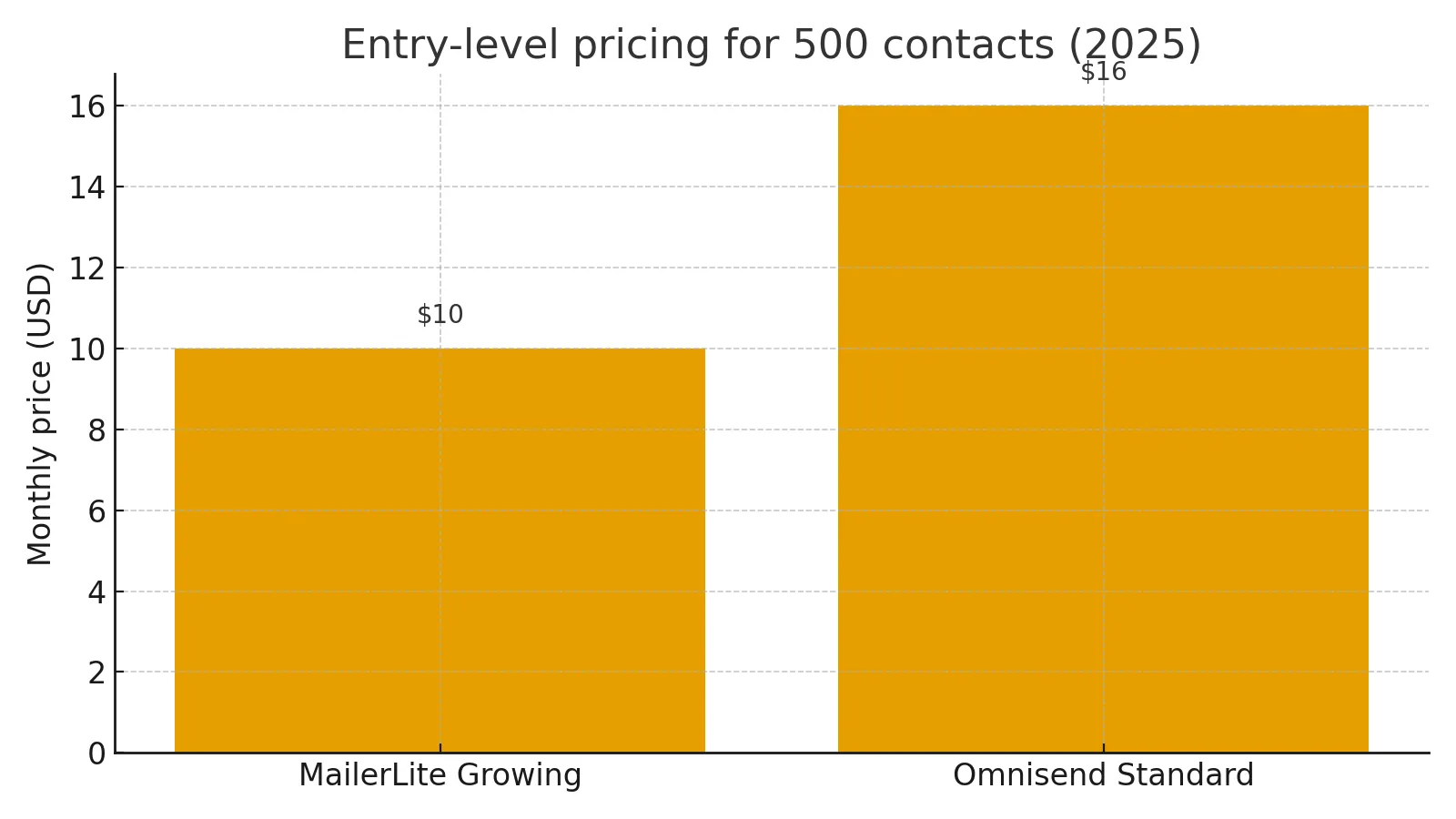
Source: official Omnisend and MailerLite pricing pages, accessed 2026. :contentReference[oaicite:7]{index=7}
Quick comparison: which tool “wins” for beginners?
| MailerLite | Omnisend | |
|---|---|---|
| Best fit for | Creators, bloggers, small lists | Ecommerce brands (Shopify/Woo) |
| Beginner-friendly UI | ✓ very clean | ✓ ecommerce-focused |
| Free plan for testing | ✓ up to 500 subs | ✓ 250 contacts + 500 emails |
| Out-of-the-box ecommerce flows | ✗ basic automations only | ✓ abandoned cart, post-purchase, win-back, more |
| Native SMS in same tool | ✗ needs separate SMS / integrations | ✓ email + SMS + push in one place |
| Price at 500 contacts (paid) | $10/mo (Growing) | $16/mo (Standard) |
| Price at 5,000 contacts | ~$39/mo | ~$81/mo (Standard) |
| Unlimited emails option | ✗ send caps by plan | ✓ Pro = unlimited emails |
| SMS credits included | ✗ no bundled SMS | ✓ Pro includes monthly SMS credits |
| Shopify & WooCommerce focus | ✓ via apps/integrations | ✓ deep ecommerce feature set |
| Landing pages & websites | ✓ unlimited pages/sites | ✓ landing pages & popups |
| Best long-term ROI for ecommerce | ✓ if you stay basic email only | ✓ when you use flows + SMS revenue |
| Overall winner for ecommerce beginners | Great for simple starts | Omnisend wins for stores |
Who should choose MailerLite vs Omnisend 2026?
MailerLite: created for simple, budget-friendly marketing
MailerLite is built for beginners, creators, solopreneurs and small businesses who need an intuitive tool to send campaigns, build landing pages and automate a few key journeys without getting lost in complexity. Reviewers consistently describe the interface as clean, modern and easy to use. :contentReference[oaicite:8]{index=8}
In 2026, MailerLite offers three core plans — Free, Growing Business and Advanced — with pricing based on your subscriber count. After the 2026 update, the free tier is limited to 500 subscribers, but still generous enough for small lists or MVP projects. :contentReference[oaicite:9]{index=9}
MailerLite is a great fit if you:
- send mainly newsletters and simple automations (welcome series, basic lead magnets),
- want a built-in landing page / website builder,
- care more about ease of use than about deep ecommerce or omnichannel features.
Omnisend: designed for ecommerce from day one
Omnisend is focused almost entirely on ecommerce brands: Shopify, WooCommerce, BigCommerce and similar stacks. Its biggest advantage over MailerLite is how much ecommerce work is handled for you:
- prebuilt abandoned cart, post-purchase, win-back and browse abandonment flows,
- on-site forms that sync directly with ecommerce segments,
- native SMS + email + push orchestration in one workflow builder. :contentReference[oaicite:10]{index=10}
For a beginner with a store, this means faster time to revenue: you can plug in proven ecommerce flows instead of building them from scratch.
Automation = revenue while you sleep. Set once, sell daily.
Pricing in 2026: what you really pay as your list grows
Let’s zoom in on the real-world pricing picture for MailerLite vs Omnisend using 2026 data and a few practical list-size scenarios.
MailerLite pricing 2026
According to recent pricing breakdowns and MailerLite’s own page, there are three main tiers in 2026: :contentReference[oaicite:11]{index=11}
- Free – up to 500 subscribers, limited sending volume and features, but enough to validate your idea.
- Growing Business – from around $10/month at 500 subscribers; adds key growth features (automations, landing pages, no MailerLite logo, etc.).
- Advanced – from around $20/month, with more advanced features (additional users, custom HTML, advanced website features, etc.).
Because pricing scales with your number of subscribers, the real question is: how quickly will you outgrow the free plan? For most ecommerce stores and fast-growing creators, this happens somewhere between 500–2,500 subscribers, especially when you start collecting leads more aggressively.
Omnisend pricing 2026
Omnisend offers Free, Standard and Pro plans, all of which include ecommerce-focused features. Several independent reviews and Omnisend’s pricing page highlight typical price points: :contentReference[oaicite:12]{index=12}
- Free – up to 250 contacts and 500 emails/month, plus basic SMS credits to try the channel.
- Standard – from about $16/month for 500 contacts (with 6,000–12,000 emails depending on tier; older pricing sits around 6,000 emails at $16).
- Pro – from about $59/month for 500–2,500 contacts, including unlimited emails and monthly SMS credits equal to your plan price (for example, $59/month plan → $59 SMS credits). :contentReference[oaicite:13]{index=13}
Where Omnisend becomes especially interesting is when you combine the Pro plan’s unlimited emails with the built-in SMS credits. For stores sending regular campaigns + flows + SMS, the blended per-message cost can be lower than stacking separate tools.
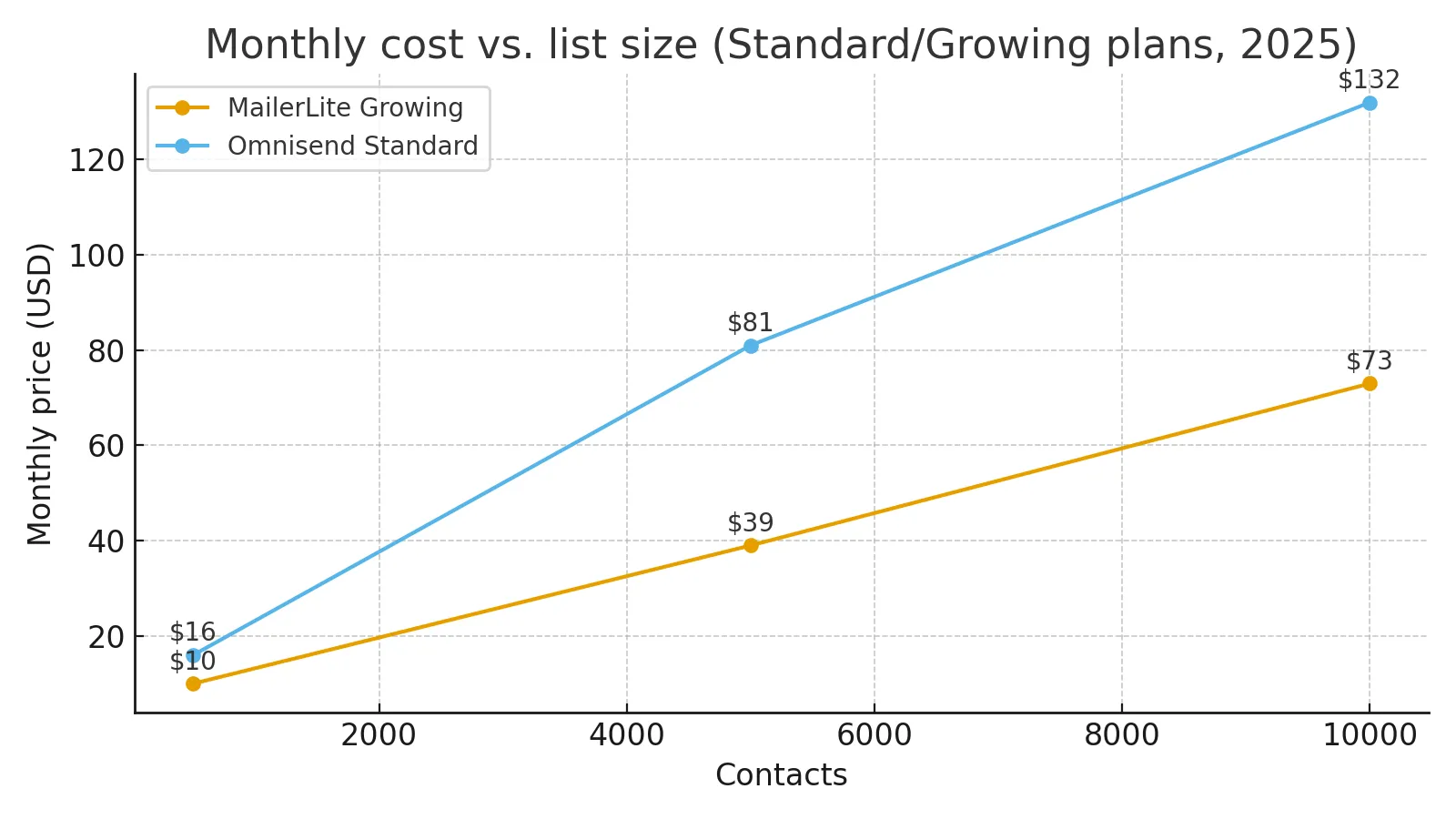
Based on third-party pricing analyses and official pages, accessed 2026. :contentReference[oaicite:14]{index=14}
Realistic pricing scenarios (beginner to growth mode)
Let’s compare the two tools at three stages:
- Stage 1 — Launch: ~500 contacts, starting to send regular newsletters and a simple welcome flow.
- Stage 2 — Growth: ~5,000 contacts, consistent campaigns and basic ecommerce flows.
- Stage 3 — Scaling: ~10,000+ contacts, multiple segments, more complex automations and possibly SMS.
| Scenario | MailerLite (est.) | Omnisend (est.) |
|---|---|---|
| Stage 1 — 500 contacts, basic sending | Free or ~$10/mo (Growing) | Free or ~$16/mo (Standard) |
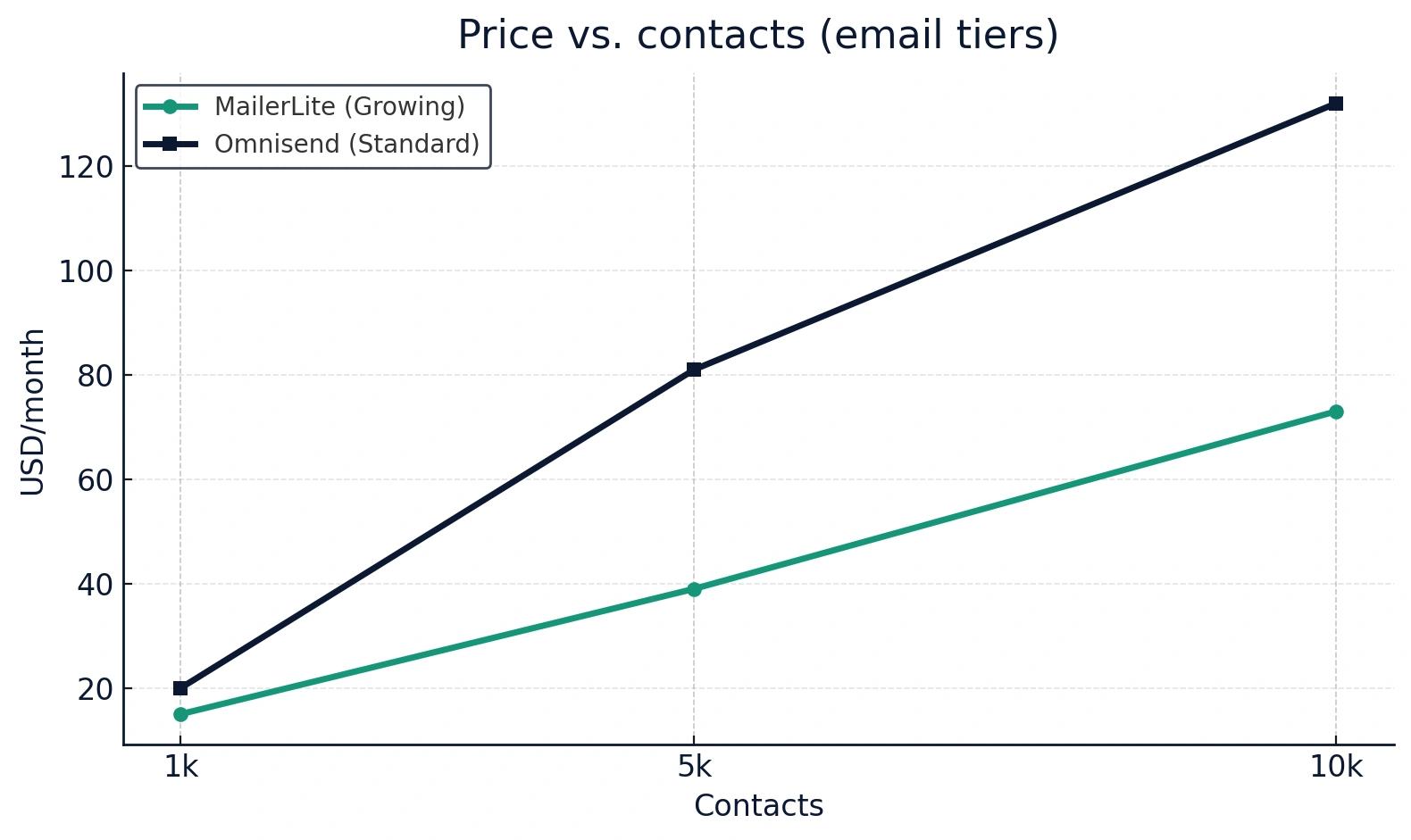
| Stage 2 — 5,000 contacts, regular campaigns | ~$39/mo | ~$81/mo (Standard) or Pro if heavy SMS |
| Stage 3 — 10,000 contacts + SMS | $73+/mo plus separate SMS tool | $132–150/mo (Standard/Pro) incl. SMS credits |
MailerLite clearly wins on pure email price at the same list size. But once you factor in:
- extra tools for SMS,
- time to set up ecommerce flows manually vs using templates,
- and the extra revenue generated by omnichannel automation,
Omnisend often pulls ahead for ecommerce stores even if the subscription fee is higher.
For pure newsletter use, MailerLite is cheaper. For ecommerce revenue workflows and SMS, Omnisend tends to deliver better payback per dollar.
Features matrix: what you actually get as a beginner
| Feature | MailerLite | Omnisend |
|---|---|---|
| Drag & drop email editor | ✓ | ✓ |
| Visual automation builder | ✓ basic flows | ✓ advanced ecommerce flows |
| Prebuilt ecommerce workflows | ✗ | ✓ abandoned cart, post-purchase, etc. |
| Native SMS in main platform | ✗ needs integrations / MailerSend | ✓ SMS + email in same flows |
| SMS credits included on higher tiers | ✗ separate cost | ✓ Pro includes credits equal to plan price |
| Landing page & website builder | ✓ strong, unlimited pages | ✓ landing pages & popups |
| Shopify integration | ✓ via app | ✓ core focus |
| WooCommerce integration | ✓ via plugin | ✓ deep ecommerce events |
| Advanced segmentation | ✓ for engagement & custom fields | ✓ ecommerce + behavior-based |
| A/B testing (campaigns) | ✓ | ✓ |
| A/B testing (flows) | ✗ limited | ✓ more mature testing in automations |
| On-site popups & forms | ✓ | ✓ |
| Product recommendation blocks | ✗ or limited | ✓ ecommerce-oriented recommendations |
| 24/7 support | ✓ on paid plans | ✓ 24/7 chat, even on free |
| Number of account users (starter tiers) | ✓ reasonable but limited | ✓ scales with spend & plan |
| AI / smart features | ✓ emerging AI helpers | ✓ smart send-time, recommendations on higher tiers |
| Deliverability reporting | ✓ | ✓ strong ecommerce reporting |
| Dedicated success manager | ✗ | ✓ on higher spend (e.g. $400+/mo) |
| Overall feature depth for ecommerce | Good for simple stores | Best-in-class for beginners moving to serious ecommerce |
Ease of use & onboarding: how fast can you launch?
MailerLite onboarding
MailerLite shines for beginners because the interface is minimal and uncluttered. If you’ve never built a campaign or landing page before, you can usually:
- Import your first 100–500 contacts,
- Pick a newsletter template,
- Launch a basic welcome automation
all within your first afternoon.
The main friction: account approval and certain advanced features (like extra users or advanced site features) are locked behind the Advanced plan. For most early-stage users, this is fine — but teams might outgrow the small plan faster than expected. :contentReference[oaicite:15]{index=15}
Omnisend onboarding
Omnisend is slightly more opinionated, but in a good way for ecommerce:
- Connect Shopify or WooCommerce, and Omnisend immediately imports your products and customers.
- You can start from pre-built ecommerce flows (welcome, abandoned cart, post-purchase, etc.).
- Default segments like “Active customers”, “High-value customers” or “Recent buyers” are ready out of the box. :contentReference[oaicite:16]{index=16}
For non-technical store owners, this often means days, not weeks to see their first automated revenue.
SMS & omnichannel: do you need it as a beginner?
Here’s where the difference is sharpest.
- MailerLite: no native SMS in the main platform. You’ll need third-party tools (like separate SMS providers) or MailerSend, and those messages usually aren’t deeply tied into your email automations. :contentReference[oaicite:17]{index=17}
- Omnisend: SMS is built into the core product, and the Pro plan includes monthly SMS credits equal to your subscription price. You can orchestrate email + SMS + push in the same workflow builder and segment by order history, location, etc. :contentReference[oaicite:18]{index=18}
As a beginner, you might think you won’t need SMS. But in ecommerce, even a simple abandoned cart SMS or shipping update can significantly improve recovery rates — often paying for the channel by itself.
ROI & payback time: when does each tool “earn its keep”?
Let’s use a very simple example:
- You run a small store with 2,500 contacts.
- Your average order value is $60.
- You send 4 campaigns per month + have basic flows (welcome + abandoned cart + post-purchase).
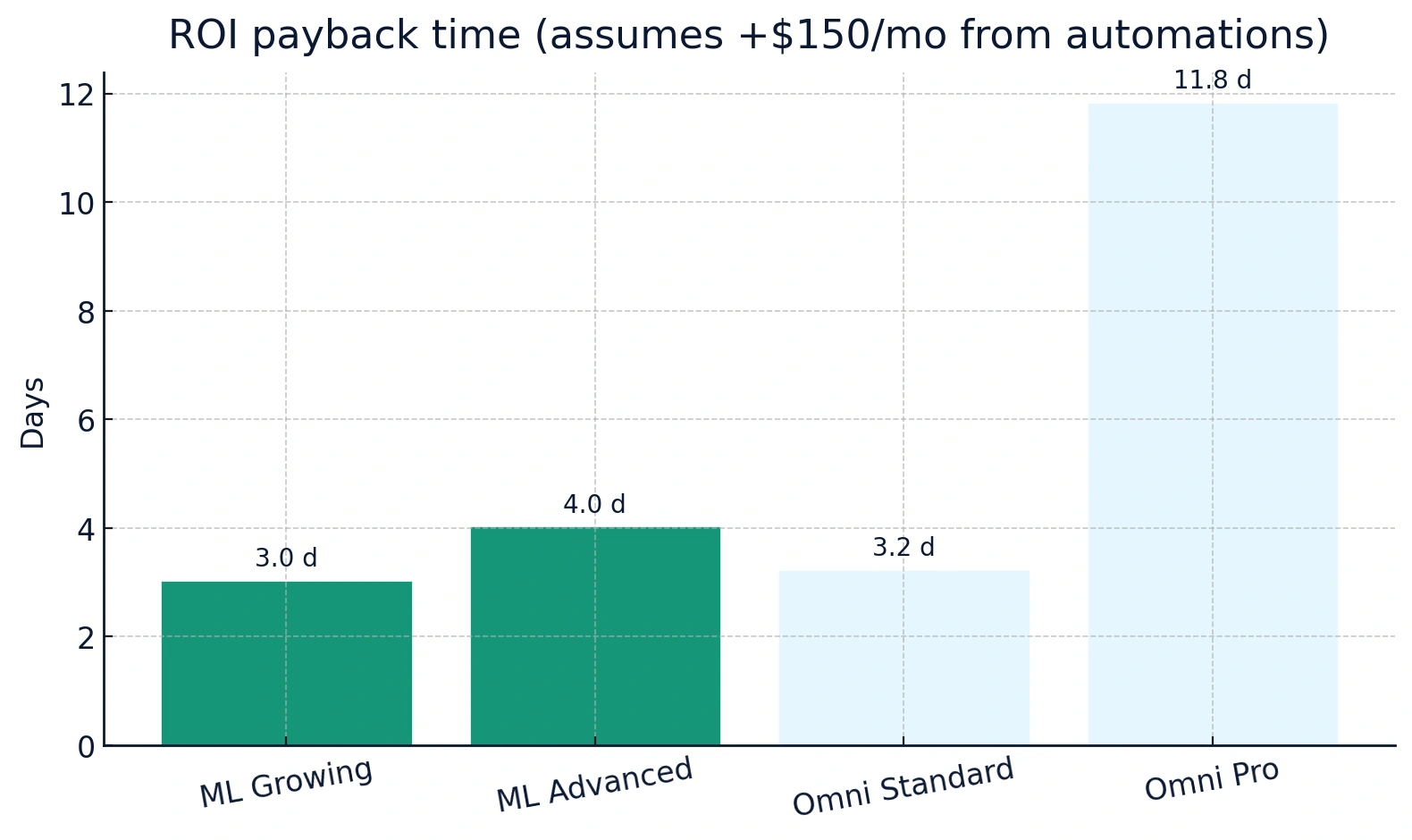
If Omnisend’s ecommerce flows and SMS reminders generate just 10–15 extra orders per month compared to basic email only, that’s $600–$900 extra revenue. Even after subtracting the difference in platform cost, the ROI can be very strong for ecommerce users.
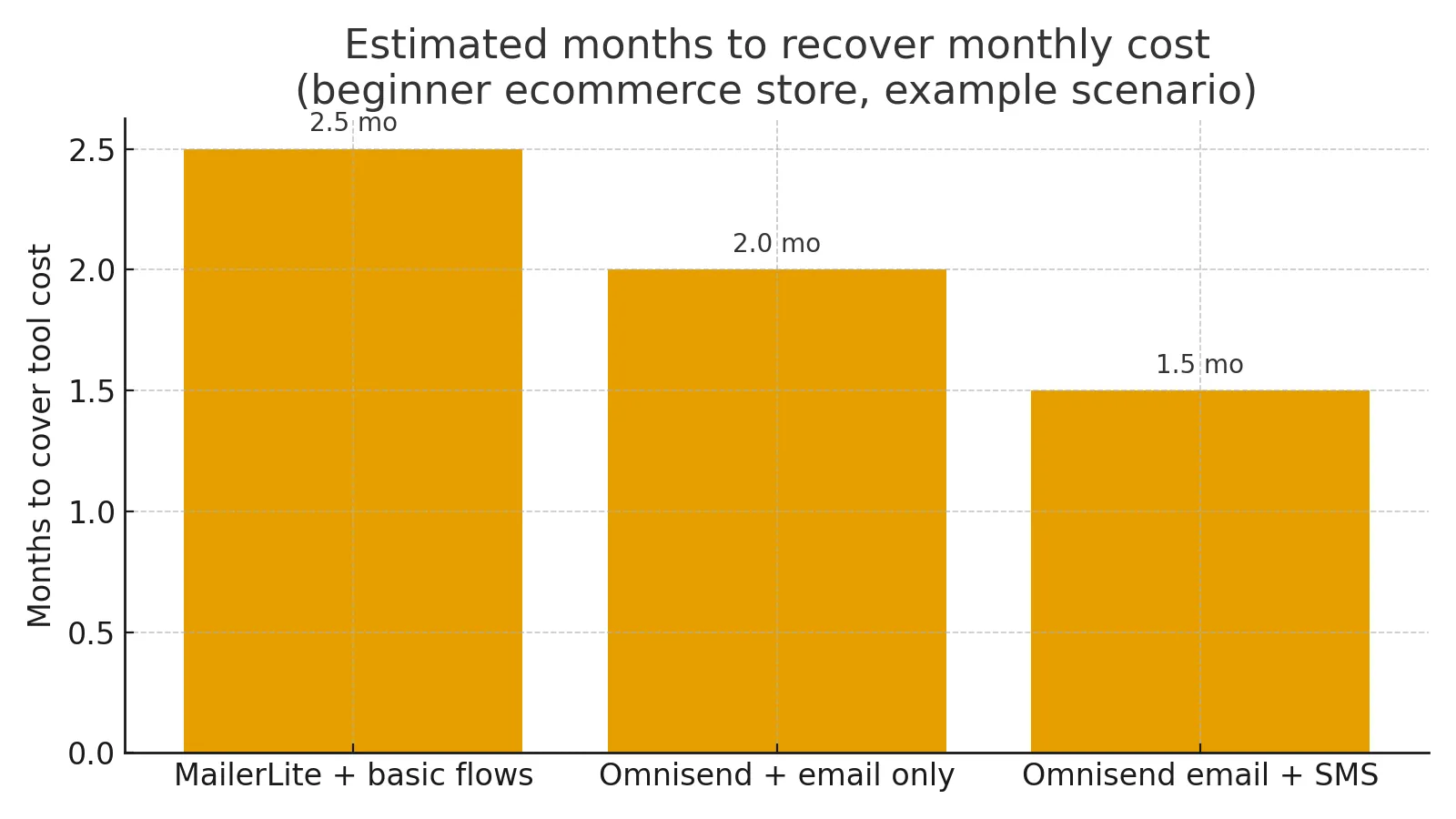
Illustrative scenario assuming modest uplift in recovered carts and repeat orders.
For ecommerce, the real question isn’t “Which tool is cheaper?” but “Which tool generates more extra orders per month?”
Final verdict: MailerLite vs Omnisend 2026
Put simply:
- If you’re a creator, blogger or small non-ecommerce business, start with MailerLite. It’s cheaper for pure email, easy to design landing pages, and you can add complexity later as you grow.
- If you run an ecommerce store on Shopify, WooCommerce or similar, start with Omnisend or migrate there once you have consistent traffic and orders. The built-in flows and SMS credits tend to pay for themselves quickly if you implement them.
From a beginner’s perspective, the decision looks like this:
- Best beginner-friendly price & simplicity: MailerLite
- Best beginner-friendly ecommerce revenue engine: Omnisend
Ready to test ecommerce-first automation with SMS built in?
Validate revenue in weeks, not months — even if you’re just starting.
Takes minutes to connect Shopify/Woo. Cancel anytime.
Just need simple newsletters and landing pages on a budget?
MailerLite keeps things clean and affordable while you grow your audience.
Start free, then upgrade when your list passes 500 subscribers.
Useful resources & further reading
- Omnisend official pricing & plan details
- Omnisend SMS pricing calculator
- MailerLite website & pricing
- Deep dive: Omnisend SMS pricing 2025 (ChooseEmailMarketing)
FAQs: MailerLite vs Omnisend for beginners
Is MailerLite really cheaper than Omnisend?
Yes, for email-only use at the same list size, MailerLite is usually cheaper — especially at 500–10,000 contacts. However, once you factor in separate SMS tools and the extra revenue from ecommerce flows, Omnisend can deliver a better ROI for online stores.
Which tool is easier to use on day one?
For plain newsletters and landing pages, MailerLite feels simpler. For ecommerce, Omnisend’s templates and default segments reduce setup time because the platform is built specifically around online store use cases.
Can I start on MailerLite and switch to Omnisend later?
Yes. Many brands start on an entry-level email tool and migrate to Omnisend once their store revenue and list size justify deeper automations and SMS. The key is to migrate before your automations become too complex to replicate.
Continue your research:
• Omnisend pricing 2025: real email & SMS costs explained
• MailerLite pricing 2025: email & landing page costs
• Best Omnisend workflows for Shopify in 2025
TL;DR
- Omnisend = TOP #1 for ecommerce stores (Shopify/Woo): built-in ecommerce blocks, strong email+SMS pairing, prebuilt revenue flows. ✓ Fastest to revenue for online stores.
- MailerLite = TOP #1 for low budget & occasional senders: $0 Free up to 500 subs and 12k emails/mo; simple UI; strong landing pages. ✓ Best starter if you email less and want low cost.
- Pricing snapshot (500 subs): MailerLite Free $0, Growing $10, Advanced $20; Omnisend Standard $16; Pro $59 (higher list entry).
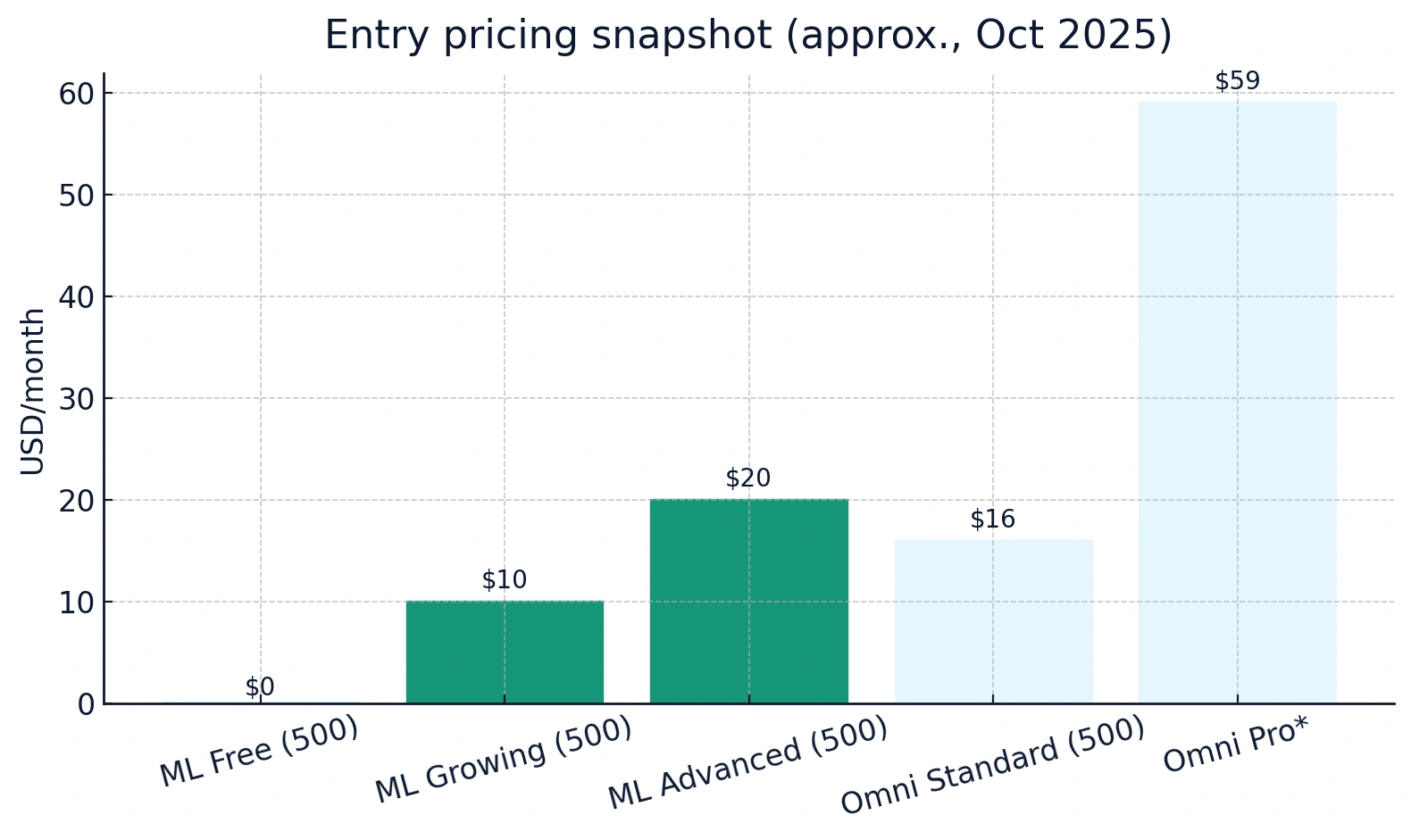
Pricing pages change often — confirm live before you decide.
Omnisend = TOP #1 for online stores (Shopify/Woo)
For ecommerce, Omnisend focuses on email + SMS with prebuilt revenue flows that map to Shopify/Woo data. It’s designed to shorten time-to-first revenue.
| Why Omnisend is TOP #1 for stores | Omnisend | MailerLite (context) |
|---|---|---|
| Built-in ecommerce flows (cart, browse, welcome, winback) | ✓ strong presets | ✓ more manual setup |
| Email + SMS under one roof | ✓ native + credits on Pro | ✗ no native SMS (integrations) |
| Shopify/Woo product blocks & feeds | ✓ | ✓ less plug-and-play |
| Send limits vs plan price (scale) | ✓ 12× list (Std), unlimited fair use (Pro) | ✓ unlimited (paid tiers) |
| Attribution & ecommerce reporting | ✓ revenue-first | ✓ lighter |
| Time to first revenue (with SMS nudge) | ✓ fast | ✓ slower |
MailerLite = TOP #1 for low budget & occasional sending
MailerLite is ideal when you send occasionally, want lowest starting costs, and need landing pages + simple automations with a clean UX.
| Why MailerLite is TOP #1 for low budget & occasional senders | MailerLite | Omnisend (context) |
|---|---|---|
| Free plan (up to 500 subs, 12k emails/mo) | ✓ $0 | ✗ free is smaller (250 subs / 500 emails) |
| Lowest paid entry | ✓ $10 (500 subs) | $16 (500 subs) |
| Unlimited sends on paid tiers | ✓ Growing/Advanced | 12× list (Std), unlimited (Pro) |
| Landing pages & websites | ✓ strong + simple | ✓ |
| UI for non-technical users | ✓ very clean | ✓ focused on ecommerce |
Fair comparison — features & pricing
| Feature | MailerLite | Omnisend |
|---|---|---|
| Free plan | ✓ 500 subs / 12k emails | ✓ 250 subs / 500 emails |
| Entry paid (≈500 subs) | $10 (Growing) | $16 (Standard) |
| 1k subs (email) | $15 (Growing) | $20 (Standard) |
| 5k subs (email) | $39 (Growing) | $81 (Standard) |
| 10k subs (email) | $73 (Growing) | $132 (Standard) |
| Monthly send limits | ✓ unlimited (paid) | 12× list (Std), ✓ unlimited (Pro) |
| Native SMS | ✗ integrations only | ✓ SMS + Pro credits |
| Prebuilt ecommerce flows | ✓ basic presets | ✓ strong presets |
| Automation depth | ✓ solid; multi-trigger on Advanced | ✓ splits + SMS orchestration |
| Best primary use-case | Low-budget, occasional sends, landing pages | Ecommerce growth with email+SMS |
Automations — what to launch first
- Welcome → First purchase: incentive + story (Day 0), bestsellers (Day 2), social proof/FAQ (Day 5).
- Abandoned checkout/cart: 1–2h reminder; Day 1 benefits; Day 2 urgency. Add SMS nudge on Omnisend Pro.
- Review request: 7–21 days post-purchase; segment by product type & AOV.
ROI & payback
If automations add around $150/month, plan payback is measured in days, not months.
Pros & cons
| MailerLite — Pros / Cons | Omnisend — Pros / Cons |
|---|---|
| Pros: ✓ great $0 entry; ✓ unlimited sends on paid; ✓ clean landing pages/UI. Cons: ✗ no native SMS; ✗ ecommerce features lighter. | Pros: ✓ ecommerce-ready flows; ✓ native SMS + Pro credits; ✓ strong reporting. Cons: ✗ paid entry higher than MailerLite; ✗ free plan cap is smaller. |
FAQs
Is MailerLite still the cheapest way to start?
When does Omnisend make more sense than MailerLite?
Do both support unlimited sends?
Final verdict
Choose Omnisend if you’re an online store and want email+SMS with prebuilt ecommerce flows and predictable scaling. Choose MailerLite if you’re budget-first, send less frequently, and value a clean page builder and simple automations.