
Updated: 27.10.2025 · Reading time: ~20–24 min
Choosing between MailerLite vs Klaviyo 2025 comes down to 3 practical questions: what you’ll pay as your list grows, how fast you can ship revenue automations, and how reliably emails land in the inbox. This deep-dive condenses the essentials for BOFU buyers: real-world pricing signals by contacts, automation templates and workflow depth, and deliverability considerations—plus a rollout plan and a data-rich features matrix so you can decide fast.
Bottom line: pick the tool that ships revenue fastest with the least ops drag. Complexity should follow revenue—not precede it.
TL;DR verdict
- Pricing & scaling: For comparable list sizes, MailerLite is typically cheaper per 1k contacts at lower–mid tiers; Klaviyo trends higher as profiles scale (more built-in ecommerce depth and ecosystem). Always verify live pages before purchase.
- Templates & speed: Both offer pre-built flows. MailerLite wins on time-to-value for small teams (clean UX, quick templates). Klaviyo wins on ecosystem signals for Shopify-centric brands that will leverage deep data and broader app integrations.
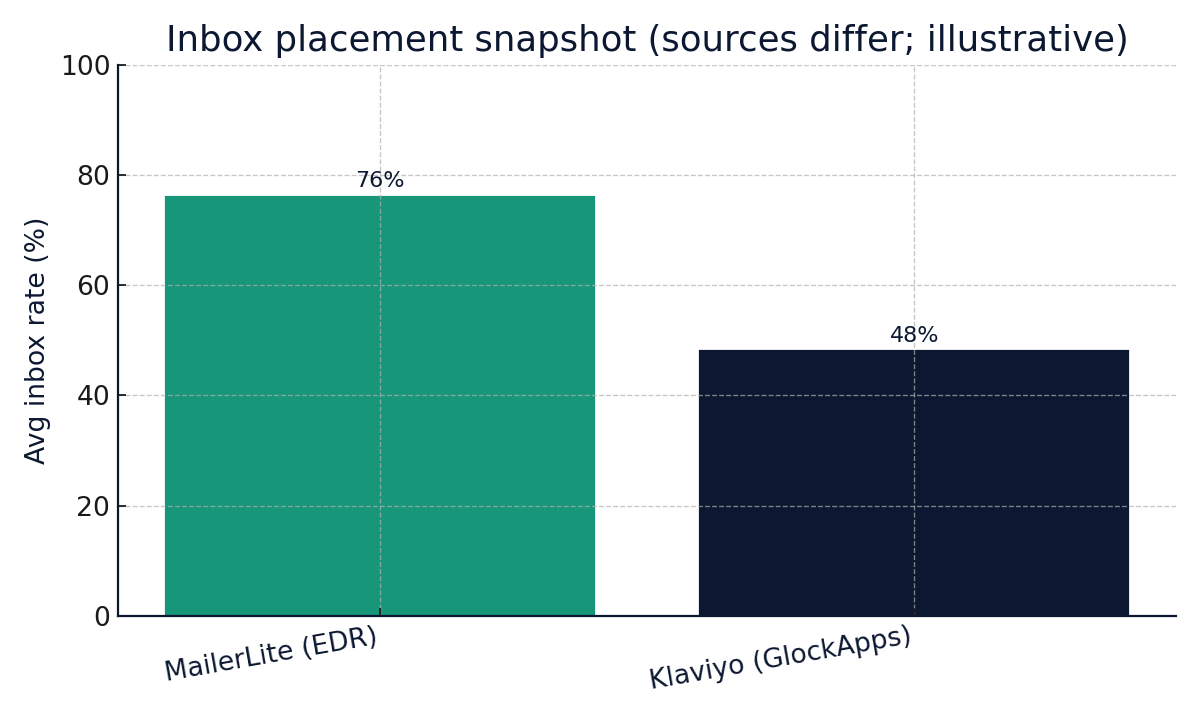
- Deliverability: Inbox placement varies by sender hygiene and content. Third-party snapshots differ; treat them as directional, not absolute. Strong domain setup + engagement-based sending beats any badge.
Validate revenue in weeks, not months. No dev team required — ready ecommerce flows.
Takes minutes to connect Shopify/Woo. Cancel anytime.
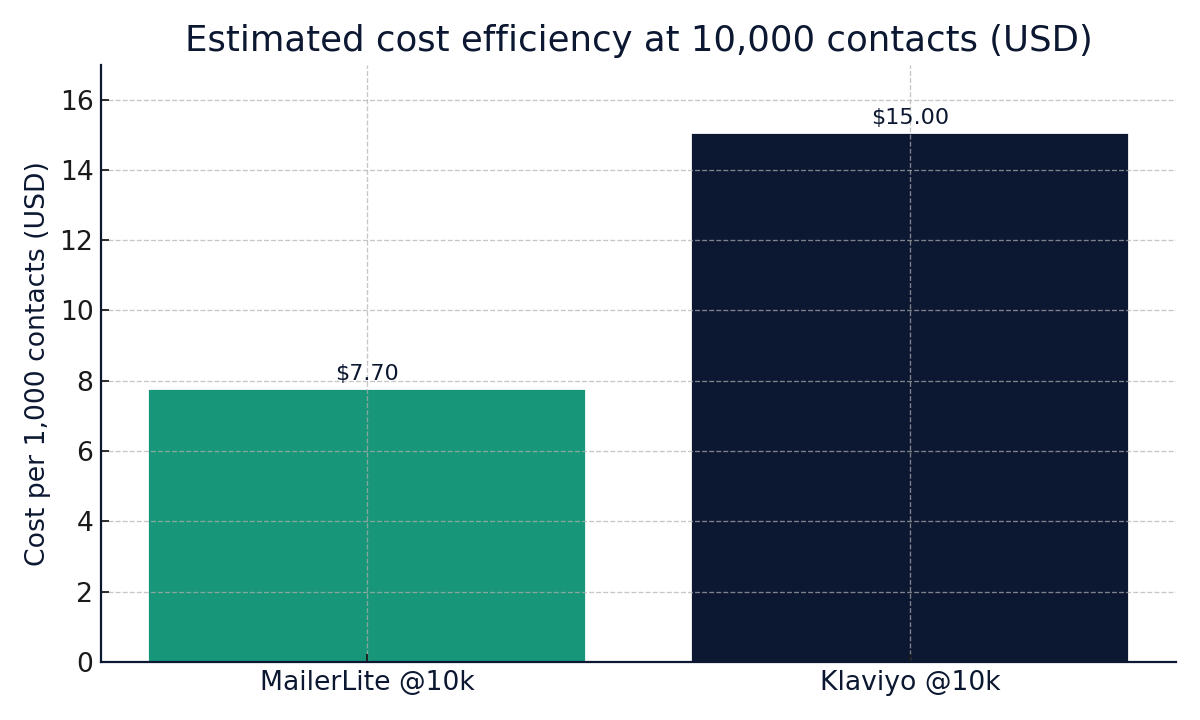
Pricing pages change often — confirm live before you decide.
Pricing: what you’ll actually pay as you grow
How pricing scales. Both tools price primarily by contacts/profiles, with feature gates by tier. Typical published entry points (rounded): MailerLite $10/mo @ 500; Klaviyo $20/mo @ 500. Expect climbs at 2.5k, 5k, 10k, 20k, etc. For budget planning, compare at your next two list milestones—not just where you are today.
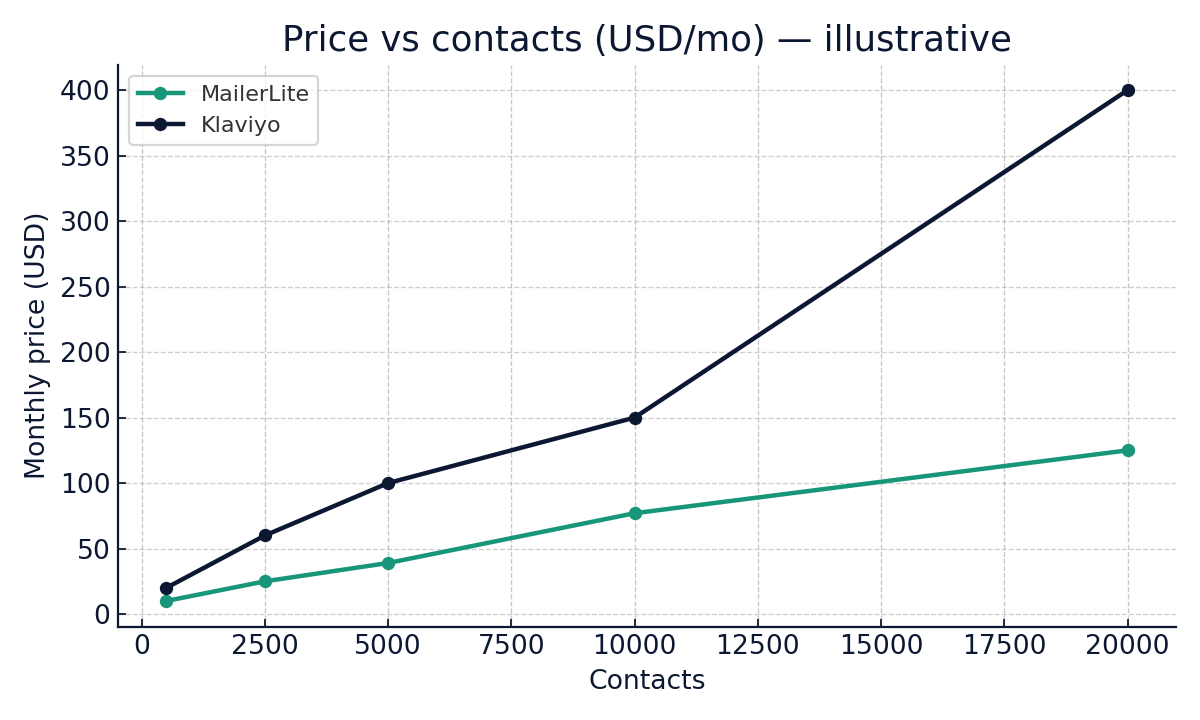
Interpretation: If you’re sub-10k contacts, MailerLite often yields a lower monthly bill for similar automation usage. As you approach 50k–100k profiles and lean into sophisticated ecommerce signals, Klaviyo’s pricing reflects its ecosystem and data depth. Neither charges “per automation,” so you can run multiple flows without per-workflow fees.
Validate revenue in weeks, not months. No dev team required — ready ecommerce flows.
Takes minutes to connect Shopify/Woo. Cancel anytime.
Automation templates & time-to-value
Templates exist to cut launch time. Here’s the practical view for BOFU teams:
- Welcome series: both platforms offer one-click starters with delays and goals. MailerLite’s editor is extremely approachable; Klaviyo’s shines when you pull in richer Shopify events and custom metrics.
- Abandoned cart: both support multi-step recovery and dynamic items. Klaviyo’s ecosystem unlocks more “if user did X/Y” branches; MailerLite keeps setup lean and fast.
- Post-purchase: education → review → cross-sell flows. Either platform can execute; the choice is whether you need deep data joins (Klaviyo) or speed and clarity (MailerLite).
- Win-back & browse: both doable; Klaviyo tends to have more native condition options; MailerLite prioritizes simplicity.
Quick comparison table
| Capability | MailerLite | Klaviyo |
|---|---|---|
| Starter price (500 contacts) | $10 (est.) | $20 (est.) |
| Template gallery breadth | ✓ | ✓ larger ecosystem |
| Workflow editor UX | clean & fast | powerful & data-rich |
| Ecommerce triggers | ✓ | ✓ deeper events |
| A/B inside automations | ✓ limited types | ✓ broader |
| Time to first live flow | < 2 hours (typical) | ~ 2–4 hours (typical) |
| Best fit | lean teams, fast ROI | data-heavy Shopify brands |
Features Matrix (24 rows)
✓ is green; ✗ is red; if a ✓ has a caveat, the caveat text is red.
| Feature | MailerLite | Klaviyo |
|---|---|---|
| Automation templates gallery | ✓ | ✓ larger set |
| Drag-and-drop workflow editor | ✓ fast | ✓ advanced options |
| Multiple triggers per flow | ✓ basic | ✓ |
| Conditional branching | ✓ | ✓ granular |
| Shopify/Woo triggers | ✓ | ✓ deep Shopify data |
| Dynamic product blocks | ✓ | ✓ |
| A/B testing inside automations | ✓ limited types | ✓ wider types |
| Send time controls & delays | ✓ | ✓ |
| Behavioral segments | ✓ | ✓ richer events |
| Product recommendations | ✓ manual/limited | ✓ smarter options |
| Webhooks / API | ✓ select | ✓ broad |
| Deliverability setup guides (SPF/DKIM/DMARC) | ✓ | ✓ robust hub |
| Analytics depth | ✓ basic-to-mid | ✓ deeper |
| Attribution clarity | ✓ simple | ✓ advanced |
| Seats / users | 3 (typical) | Varies by plan |
| Permissions & roles | ✓ basic | ✓ granular |
| SSO / advanced security | ✗ | ✓ |
| Landing pages / sites | ✓ unlimited | ✓ builder via apps |
| Forms & popups | ✓ | ✓ |
| Transactional messages (via integrations) | ✓ | ✓ |
| Ecommerce ecosystem depth | solid core | very strong |
| Reporting & dashboards | ✓ less granular | ✓ granular |
| Onboarding resources | guides & templates | academy + ecosystem |
| Community & partners | growing | very large |
Deliverability: what really matters
Two truths in 2025: inbox providers tightened filters, and sender behavior now outweighs tooling badges. Third-party snapshots vary widely, so treat them as directional checks—not gospel. What you control:
- Authentication: SPF, DKIM, DMARC, aligned sending domain, branded links.
- Engagement-based sending: exclude unengaged segments; protect reputation first.
- List quality: verified opt-ins, bounce hygiene, low complaint rates.
- Cadence & content: consistent schedules, clear expectations, low-friction CTAs.
ROI & payback: simple math
Assume a modest ecommerce brand at 10k contacts. Launch three flows (welcome, cart, post-purchase). Even conservative conversion lifts typically cover a mid-tier subscription within weeks. The compounding comes from always-on automations—ship v1 now, then iterate with subject tests and timing tweaks.
Fast rollout (60–180 minutes)
- Connect store + verify domain (SPF/DKIM/DMARC) → better inbox placement from day one.
- Load templates: Welcome (2–3 emails), Abandoned cart (2–3 steps), Post-purchase (education → review → cross-sell).
- Segments: engaged 90-day, recent buyers, high-AOV, lapse-risk 60/90-day.
- QA: trigger tests, coupon validity, mobile previews, time zone checks.
- Ship v1 + A/B: keep changes small; protect engagement thresholds.
Validate revenue in weeks, not months. No dev team required — ready ecommerce flows.
Takes minutes to connect Shopify/Woo. Cancel anytime.
FAQ
Which is cheaper? At lower–mid list sizes, MailerLite usually bills less per 1k contacts. As profiles scale and data needs expand, Klaviyo’s price reflects its deeper analytics and ecosystem.
Which ships faster? Small teams typically go live faster on MailerLite’s templates. If you need complex multi-signal branching from day one, Klaviyo’s data layer pays off.
Who “wins” on deliverability? No platform guarantees inboxing. Authentication + engaged sending + list hygiene win. Use each platform’s deliverability tooling and monitor GPMT (Gmail) and dashboard trends.
Can I migrate later? Yes. Lock early wins with simpler tooling; migrate when data complexity justifies it.
References
- MailerLite pricing: official; free plan update FAQ (500 subscribers cap).
- Klaviyo pricing: official; independent cost breakdowns and guides.
- Deliverability resources: Klaviyo Deliverability Hub (help docs); MailerLite best practices; third-party test snapshots (Email Deliverability Report, GlockApps).
Final verdict
If you’re a lean Shopify/Woo team aiming for fast revenue per setup hour, start with MailerLite, ship the three core flows, and scale. If your roadmap requires deeper Shopify data signals, larger partner ecosystem, and analytics granularity, Klaviyo earns its price tag—especially as you cross into higher contact tiers. In either case, your outcomes hinge on sender hygiene, segment discipline, and relentless iteration—not just feature lists.
Next reads:
MailerLite Pricing explained ·
Best Marketing tool for business ·