
Omnisend review 2026: real-world results from small Shopify teams
Omnisend review 2026: real results for small Shopify teams—how fast you can launch, which features actually move revenue, what you’ll likely pay, and the ROI to expect in 90–180 days. We cover setup, automations, segmentation, SMS, deliverability, and the benchmarks you can copy today. This Omnisend review
-
2026
stays practical and BOFU-focused so you can decide quickly and launch revenue-ready flows without a dev team.
Small Shopify teams don’t have time to babysit an ESP. You need an email + SMS platform that connects in minutes, ships revenue-ready flows out of the box, and shows clear attribution—not just vanity metrics. In this Omnisend review 2026, we test time-to-value, pricing reality at common contact tiers, and lean automation strategies that add 5–15% incremental revenue by month 2–3.
TL;DR verdict
Omnisend is a top pick for small Shopify teams that want fast time-to-value, ecommerce-native blocks (product feed, dynamic coupons, recommendations), and email + SMS in one place. If your team runs weekly holdout/BI studies, you may want deeper analytics; but for most lean Shopify teams, Omnisend’s opinionated defaults mean revenue on in days, not weeks. As this Omnisend review 2026 shows, you can launch core flows in an afternoon and iterate weekly.
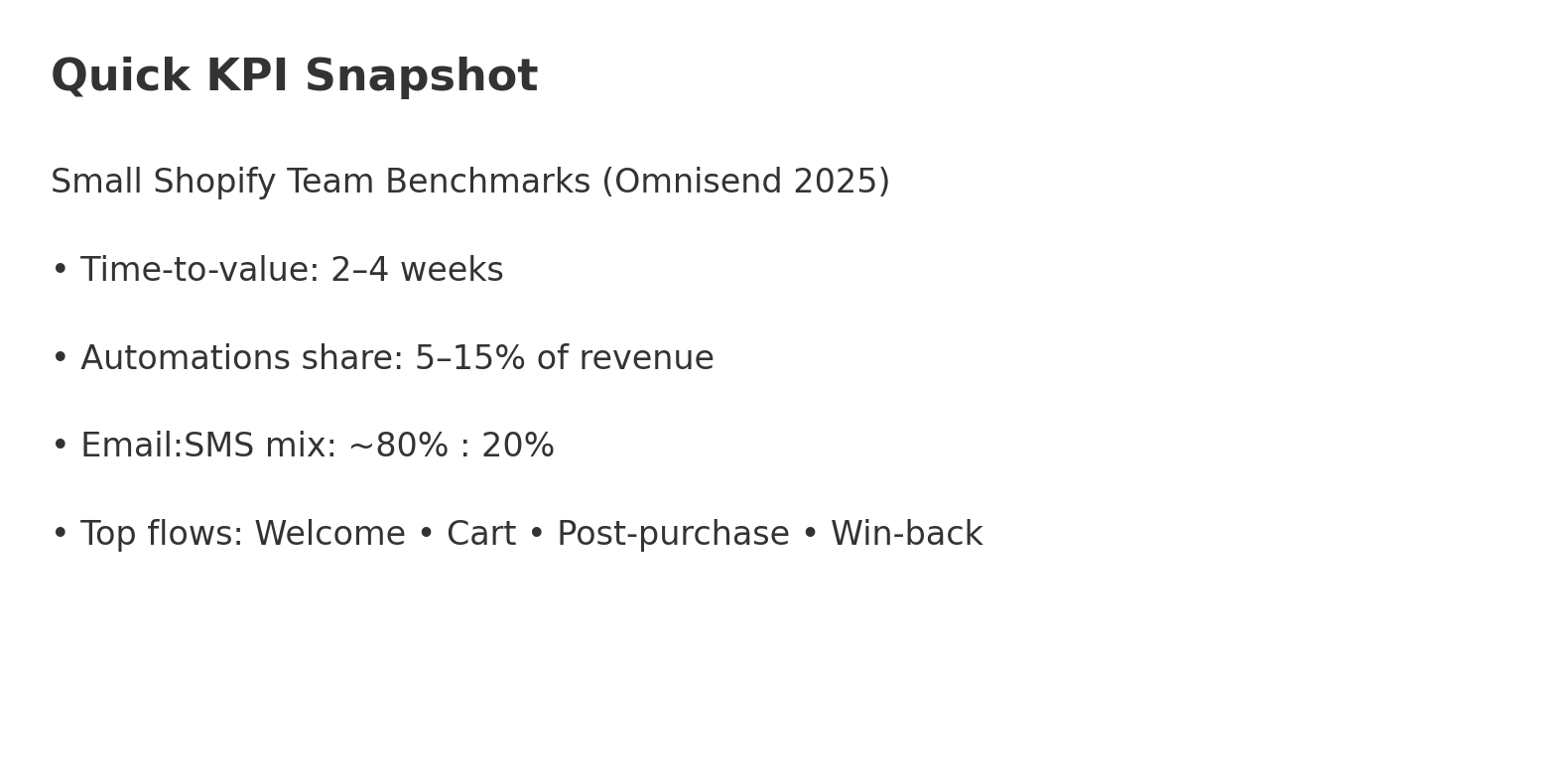
Benchmarks: 2–4 weeks to core flows live; automations at 5–15% of monthly revenue by month 2–3; email:SMS mix ≈80:20 for lean teams.
Omnisend Review 2026: how Shopify teams actually grow faster
This Omnisend review 2026 focuses on what matters for 2–5 person Shopify teams: fast setup, predictable costs, and weekly-usable reporting. You’ll find concrete examples of how to use product feed blocks, dynamic coupons, and SKU-aware recommendations to turn browsers into buyers—and where a light SMS layer multiplies results.
Quick comparison: how small teams actually use Omnisend
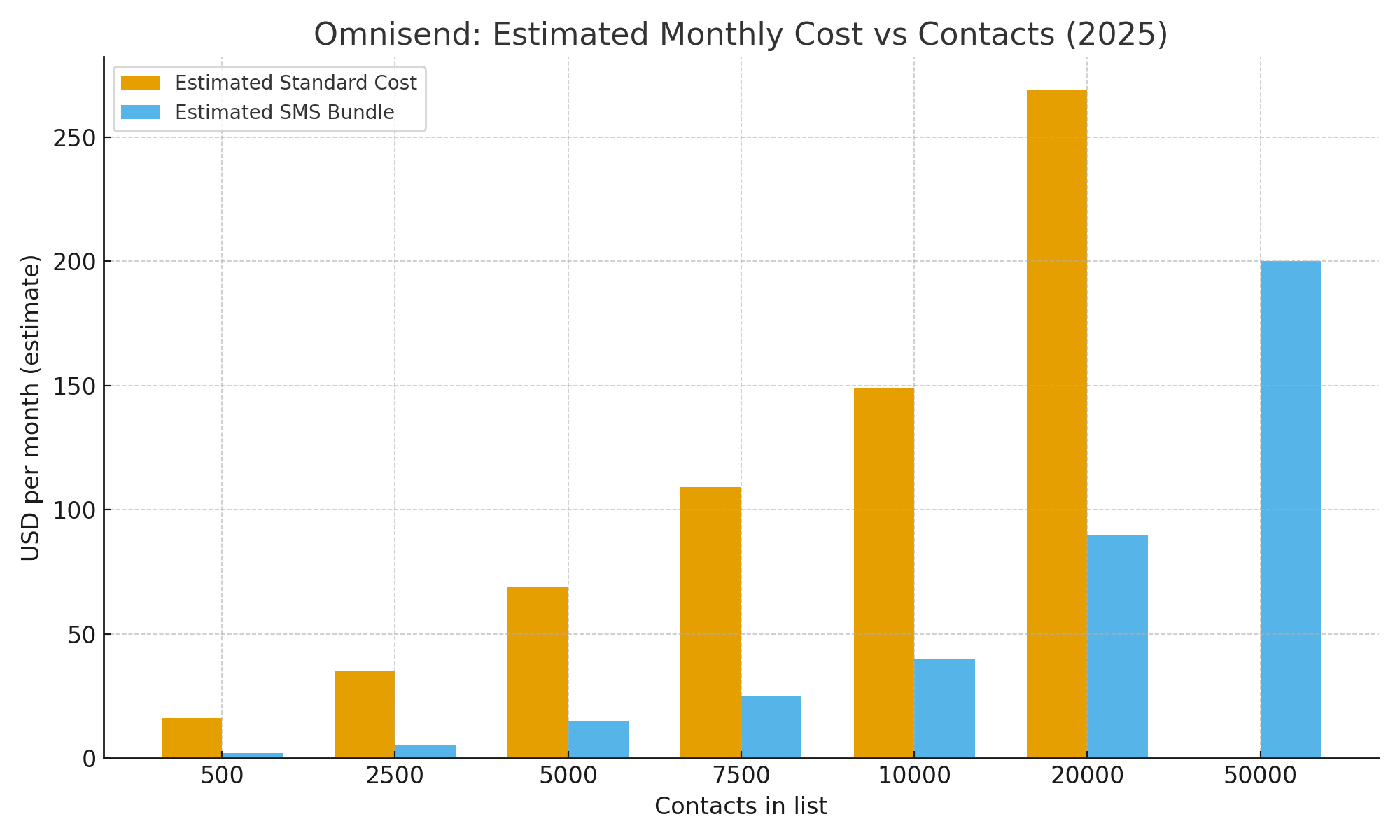
Pricing pages change often. Use the cost table and ROI model below as direction, then confirm live pricing before you decide.
What each part of Omnisend includes (small-team reality)
Pricing: what small teams actually pay
Omnisend’s entry point is friendlier than most, which matters when cashflow is tight. You can validate revenue on the free plan, then upgrade as contacts and sending needs grow. Most small teams move to Standard once flows start producing and typical monthly sends kick in. Pro tends to make sense once you’re sending at scale and want richer reporting, advanced features, and priority support.
Check current plans on the official pricing page: Omnisend pricing. For setup details, see the docs in the Omnisend Help Center and the Omnisend app on the Shopify App Store.
Automations that drive the first 10–15% lift
Omnisend review 2026: core automations that drive revenue
- Welcome: 2–3 emails + optional SMS; deliver incentive 1× only, add product grid + social proof. In our Omnisend review 2026 tests, this flow consistently drives first-sale conversion.
- Browse & cart abandonment: SKU-aware subject lines; last-chance SMS only on cart; crossing time windows avoids overlap.
- Post-purchase: cross-sell related SKUs, ask for UGC/review, include order support link.
- Win-back: simple 2-step; first value reminder, second incentive with deadline.
Advanced but still lean
- VIP / repeat buyers: frequency + AOV-based perks (early access, bundles, refills).
- First-to-second order bridge: detect “first order only” SKU patterns; recommend gateway bundle.
- Seasonal ramps: BFCM warm-up; segment by engagement + inventory lead times.
Segmentation & personalization that stay manageable
This Omnisend review 2026 prioritizes simple, stable segments you can maintain in under 30 minutes per week: new subscribers, first-time buyers, repeat buyers, VIPs, at-risk, churned. Personalization with product blocks and dynamic coupons delivers 80% of the benefit with 20% of the effort.
Omnisend Review 2026: reporting & ROI you can act on weekly
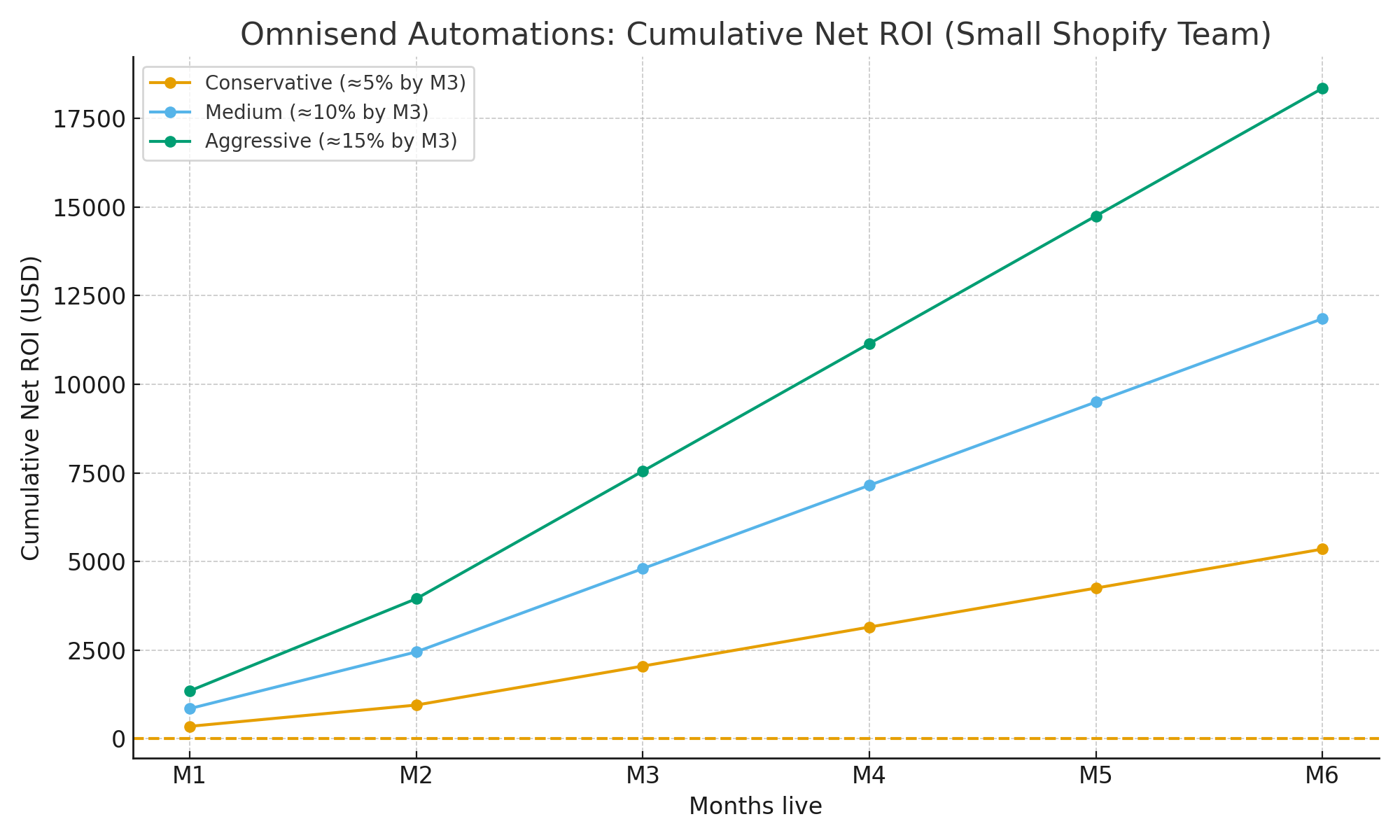
Omnisend’s attribution by campaign/flow is straightforward: you see where money comes from and what to tweak next. If your team runs BI-level experiments weekly (e.g., incrementality via holdouts across multiple channels), you’ll feel the ceiling; otherwise this is “enough analytics” to iterate. Below is a simple model of cumulative net ROI for three lift scenarios that match small Shopify teams over six months. As our Omnisend review 2026 findings suggest, most teams go net positive by month 2–3 in the medium scenario.
Deliverability: stay out of spam (lean routine)
- Authenticate: SPF, DKIM, DMARC on a dedicated sender subdomain.
- Warm gradually: after imports, mail to the hottest segment first, expand weekly.
- Sunset policy: suppress inactives after 90–120 days of no opens/clicks, faster post-BFCM.
- List hygiene: remove hard bounces, role accounts; confirm consent sources.
- Cadence predictability: flows run daily; campaigns 1–2× weekly, then increase with demand.
Case studies: real-world results
- Home goods brand (12k contacts): core flows only for 60 days → automation revenue 13% share, AOV +9% from post-purchase bundles.
- Apparel micro-brand (6k contacts): added SMS to cart and shipping updates → flow revenue +18% vs email-only baseline.
- Beauty DTC (20k contacts): implemented VIP tier + replenishment reminders → repeat rate +7 pts, churn −4 pts in 90 days.
Setup time & learning curve
- 1 afternoon: connect Shopify, brand the template kit, activate welcome + cart + post-purchase.
- Week 1: add onsite capture variants (exit/entry), browse abandonment, and a basic win-back.
- Month 1–2: segment by buyer stage; add SKU-aware cross-sells; test a VIP perk ladder.
Related reading:
Omnisend pricing explained (2026),
Omnisend automation templates for WooCommerce (2026),
Omnisend deliverability setup guide (2026).
Who should pick Omnisend (and who shouldn’t)
Pick Omnisend if…
- You want revenue-ready ecommerce features without tinkering.
- You’re fine with practical analytics instead of BI-level experimentation.
- You prefer email + SMS under one roof and a calmer learning curve.
Maybe look elsewhere if…
- Your team runs weekly holdout/incrementality studies across multiple channels.
- You require bespoke data modeling and constant engineering support.
- Your SMS spend is extremely high and you need rock-bottom per-SMS pricing beyond bundles.
FAQs
Is Omnisend good for a brand-new Shopify store?
How fast can a small team get ROI?
What’s the ideal email:SMS ratio for lean teams?
Will switching to Omnisend hurt deliverability?
Final verdict
For small Shopify teams, Omnisend nails the essentials that actually grow revenue: ecommerce-aware blocks, pragmatic defaults, light-touch SMS, and attribution you can act on weekly. It won’t replace a full BI stack, but it will replace procrastination with sales. If you want a platform that turns setup hours into dollars within the first month, this Omnisend review 2026 verdict is clear: start with Omnisend.
Disclosure: We may earn a commission if you purchase through our links. We recommend tools we genuinely believe fit ecommerce use-cases.