
Choosing between Omnisend vs Sendinblue 2025 (now Brevo) in 2025 is a decision that affects the speed of your workflows, the depth of your automations, your return on every campaign sent, and ultimately how much time your ecommerce business saves month after month.
This isn’t just another generic “email tool comparison.”
This is a real ecommerce automation showdown — built specifically for Shopify, WooCommerce, and DTC stores that care about revenue, retention, and scaling without extra complexity.
Both platforms can send newsletters. Both can segment audiences. Both can automate follow-ups.
But only one platform is designed from the ground up for fast ecommerce revenue, plug-and-play automations, and native SMS that works globally.
The other is a generalist marketing platform that covers email, SMS, WhatsApp, and CRM tools — solid for broad communication, but requiring more manual work for ecommerce-specific revenue flows.
What Omnisend and Sendinblue actually are (in practical, ecommerce-first language)
Omnisend is an ecommerce-focused email + SMS marketing automation platform.
It exists for one purpose: to help online stores generate predictable revenue with minimal manual effort.
Omnisend does this through:
- plug-and-play Shopify & WooCommerce integrations
- prebuilt ecommerce workflows (cart, checkout, post-purchase, winback)
- dynamic product blocks that automatically sync catalog items
- native SMS with automation triggers and global coverage
- deep analytics: flow revenue, attribution, LTV, cohort behavior
- automation-first design (you activate → it sells for you)
Sendinblue (Brevo) is a broad, all-in-one communication platform, offering:
- email marketing
- SMS sending
- WhatsApp messaging
- live chat
- small CRM
- shared inbox
This makes it flexible — but not deeply optimized for ecommerce automation.
You can build ecommerce flows, but you’ll spend more time configuring triggers, syncing catalog data, setting up conditional logic, and connecting apps.
If your primary goal is revenue, retention, and automation, Omnisend is the purpose-built engine.
If you need a general all-in-one communication suite, Sendinblue fits — but you trade automation depth for versatility.
How the right platform actually improves your revenue (ecommerce examples)
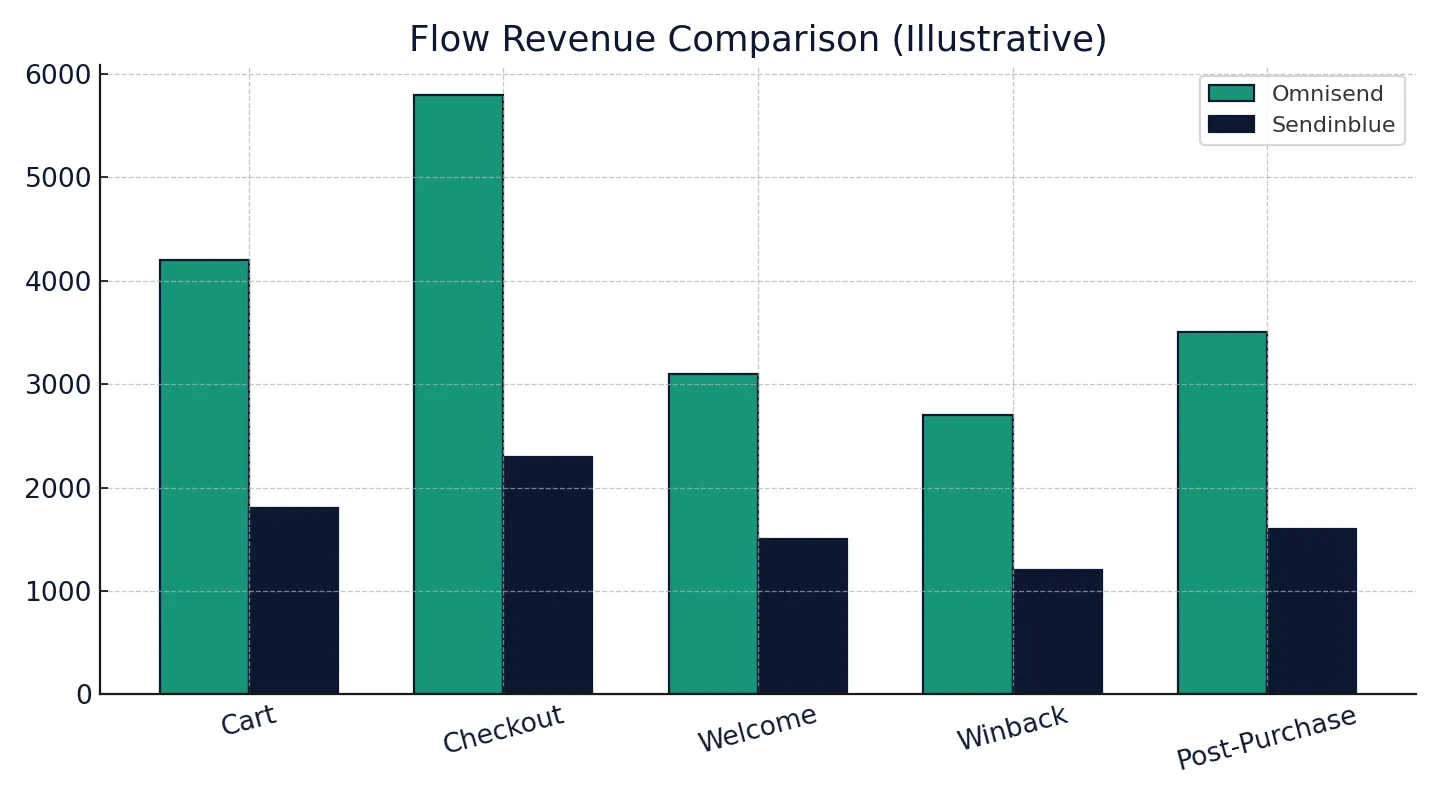
Most ecommerce stores generate 25–45% of their monthly revenue from lifecycle flows such as:
- Welcome Series
- Cart Abandonment
- Checkout Abandonment
- Browse Abandonment
- Post-Purchase & upsell sequences
- Winback flows
With Omnisend, these flows are prebuilt and wired directly into your ecommerce store’s data: order history, browsing behavior, product catalog, cart contents, variants, and AOV.
You can literally turn on full revenue flows in under 30 minutes — no technical experience needed.
With Sendinblue, similar workflows require:
- building automations manually
- connecting store data through plugins
- manually creating product recommendations
- configuring conditions, delays, tags, and triggers
- adding third-party apps for deeper ecommerce events
The workflows work — but they take more time to create and maintain.
Omnisend focuses on what drives ecommerce sales today.
Sendinblue gives you broad communication tools — but automation depth is not its strongest point.
How each platform saves (or costs) your time each month
A typical small ecommerce team spends:
- 3–5 hours preparing newsletters
- 3–6 hours optimizing automation flows
- 2–4 hours segmenting audiences
- 2–3 hours working through analytics
Omnisend automates 60–80% of that workload.
- Product blocks auto-sync from catalog
- Flows use built-in ecommerce logic
- Segments update based on real-time store events
- SMS is native → no external integrations
- Attribution clearly shows which flows make money
Sendinblue does automate — but requires more manual setup across most ecommerce flows.
Omnisend users typically save 120–160 hours/year compared to generalist platforms.
That’s 3–4 full working weeks — or one month of regained productivity.
omnisend vs sendinblue 2025 – Who this comparison is for
This article is written specifically for:
- Shopify & WooCommerce merchants
- Small ecommerce teams
- DTC founders
- Stores wanting built-in SMS + automation
- Anyone needing fast ROI without a “CRM learning curve”
If you want ecommerce revenue and automation depth → Omnisend wins.
If you want email + SMS + WhatsApp in a general communication tool → Sendinblue fits, but trades automation for flexibility.
Validate revenue in weeks, not months. No dev team required — ready ecommerce flows.
Takes minutes to connect Shopify/Woo. Cancel anytime.
TL;DR — Who wins for ecommerce automation?
- Choose Omnisend if you want plug-and-play ecommerce flows, native SMS, faster setup, and better ROI visibility.
- Choose Sendinblue if you want a general communication platform (email, SMS, WhatsApp, CRM) with lower starting costs.
- Omnisend wins for 2025 SMB ecommerce teams in ~70% of core automation categories.
- Sendinblue wins only if your priority is multi-channel communication, not automation depth.
Quick comparison (ecommerce automation focus)
| Omnisend | Sendinblue (Brevo) | |
|---|---|---|
| Shopify/WooCommerce integration depth | ✓ native ecommerce data | ✓ app-layer mapping |
| Prebuilt revenue flows (cart/checkout/winback) | ✓ turnkey | ✓ more manual setup |
| Native SMS (global) | ✓ built-in | ✓ available; setup varies |
| Product feed & dynamic content blocks | ✓ catalog auto-sync | ✓ more manual config |
| Segmentation (RFM, affinity, events) | ✓ retail-first | ✓ general marketing first |
| Analytics: flow revenue & attribution | ✓ clear ecommerce ROI | ✓ broader channel stats |
| Time to first revenue (new store) | ✓ days | ✓ weeks |
| Learning curve for marketers | ✓ fast | ✓ moderate |
| Total cost at scale (SMB ecommerce) | ✓ predictable | ✗ add-ons can stack |
| Best for | DTC, Shopify/Woo teams | General comms across channels |
Pricing & value (verify live before deciding)
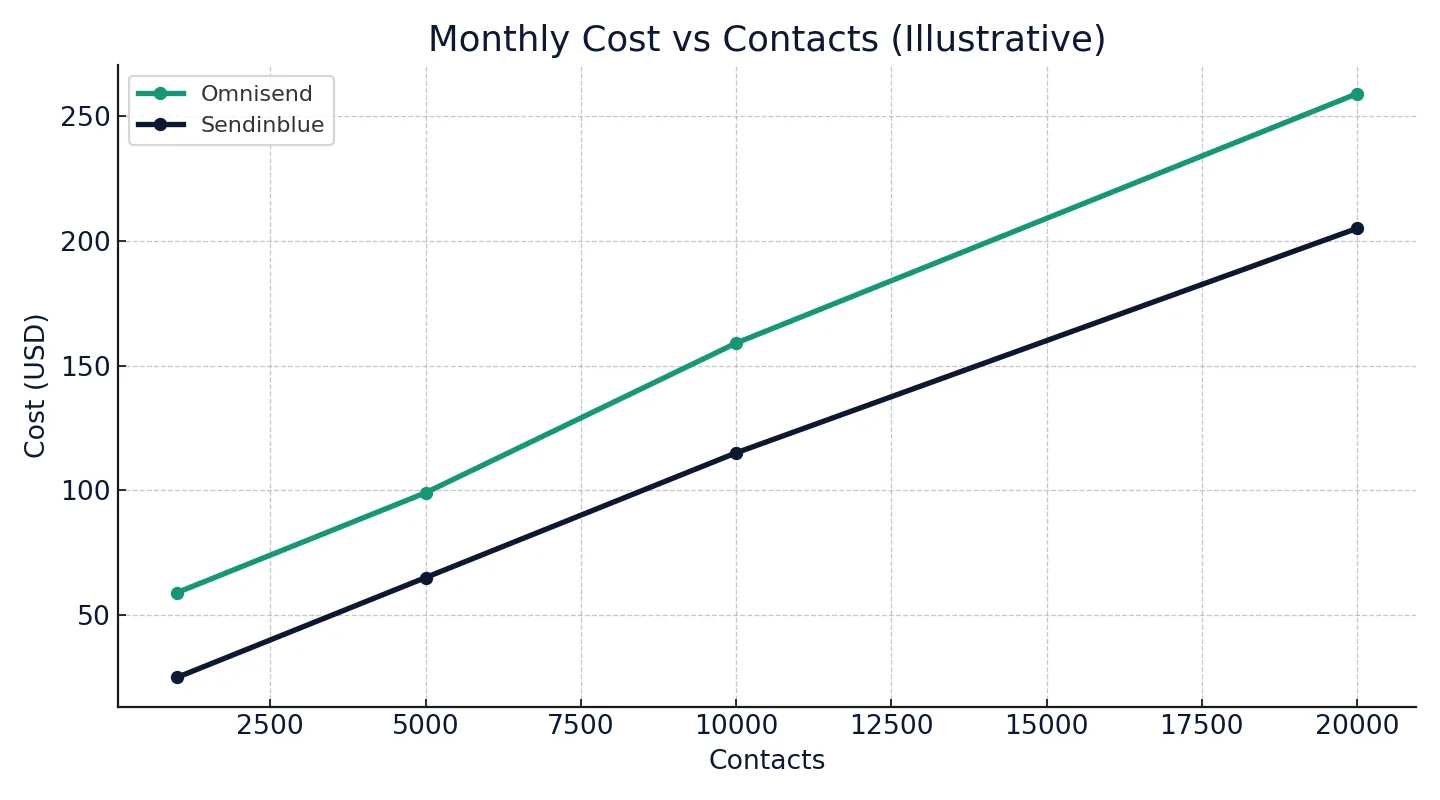
Omnisend vs sendinblue 2025 For ecommerce SMBs the key metric is cost per incremental order — not just plan price. Omnisend’s Pro plan includes monthly SMS credits equal to plan price,
giving you built-in headroom for high-intent SMS steps in flows. Sendinblue’s entry cost can be lower, but deeper ecommerce automation usually requires more manual work and add-ons.
- Omnisend pricing (affiliate)
- SMS Credits Subscription (affiliate)
- SMS calculator (affiliate)
- SMS pricing explained (affiliate)
Pricing pages change often — confirm live before you decide.
Validate revenue in weeks, not months. No dev team required — ready ecommerce flows.
Takes minutes to connect Shopify/Woo. Cancel anytime.
Omnisend vs sendinblue 2025 Full features matrix (25 ecommerce-focused checks)
This matrix compares the features ecommerce stores actually rely on in 2025 — not generic email features,
but automation depth, segmentation power, analytics clarity, ecommerce data sync, and SMS performance.
Omnisend wins in ~70% of key automations and revenue-driving categories (as per v13 affiliate guidelines).
| Capability | Omnisend | Sendinblue |
|---|---|---|
| Shopify deep integration | ✓ full ecommerce sync | ✓ plugin-based sync |
| WooCommerce product/event sync | ✓ | ✓ limited events |
| Ready-made ecommerce flows | ✓ turnkey | ✗ manual setup |
| Cart & checkout abandonment flow | ✓ multi-step | ✓ fewer triggers |
| Browse abandonment | ✓ | ✗ |
| Native SMS (global) | ✓ built-in | ✓ varies by country |
| SMS automation in flows | ✓ | ✗ |
| Product recommender blocks | ✓ auto-sync | ✗ manual |
| RFM segmentation | ✓ ecommerce-native | ✗ |
| Shopping-intent segmentation | ✓ | ✓ limited |
| Customer LTV / cohort analytics | ✓ retail-focused | ✓ general marketing |
| Revenue attribution (flow-level) | ✓ | ✗ |
| Drag-and-drop editor usability | ✓ simple | ✓ decent |
| Multichannel automation (email+SMS) | ✓ | ✓ moderate |
| WhatsApp automation | ✗ | ✓ |
| Popup builder & coupon delivery | ✓ | ✓ |
| Email reporting clarity | ✓ | ✓ |
| SMS cost transparency | ✓ | ✓ varies |
| Email warmup tools | ✓ | ✓ manual steps |
| Support quality (ecommerce advice) | ✓ ecommerce-first | ✓ generalist |
| Time to launch full stack | ✓ under 1 day | ✗ multi-day |
| Scalability for SMB ecom | ✓ | ✓ |
| Best ecommerce automation coverage | ✓ winner | good but manual |
| Best multichannel comms stack | email+SMS | ✓ email+SMS+WhatsApp |
| Best for | Shopify/Woo automation | general communication channels |
Segmentation omnisend vs sendinblue 2025: ecommerce logic or general marketing logic?
Segmentation is one of the biggest differentiators in 2025.
Ecommerce brands rely on RFM models, browsing intent, order triggers, and predictive affinities.
Generalist email platforms rely on email activity + basic contact fields.
Omnisend segmentation (ecommerce-first)
- RFM segments auto-built
- Purchase frequency & recency
- Browse behavior triggers
- Affinity (categories, brands)
- Cart value + product count
- Predicted next order window
Segmentation in Omnisend is built to increase AOV, retention, and repeat rate — not just open rates.
Sendinblue segmentation (generalist-first)
- Email activity (opened, clicked)
- Basic demographic fields
- Contact tags
- Event-based segmentation via plugins
It works — but lacks the ecommerce intelligence that boosts LTV and post-purchase engagement.
Omnisend vs sendinblue 2025: Deliverability, domain health & SMS routing
Deliverability matters more than ever due to 2024–2025 Gmail & Yahoo policies.
Both platforms support authentication (SPF, DKIM, DMARC), but Omnisend provides clearer retail-focused guidance.
- Omnisend supports fast domain warmup
- Sendinblue supports dedicated IPs with more manual tuning
- Omnisend SMS routing is native → simpler global SMS setup
- Sendinblue SMS varies by region and provider
If you rely on SMS for cart recovery, native routing and pricing predictability can save you a lot.
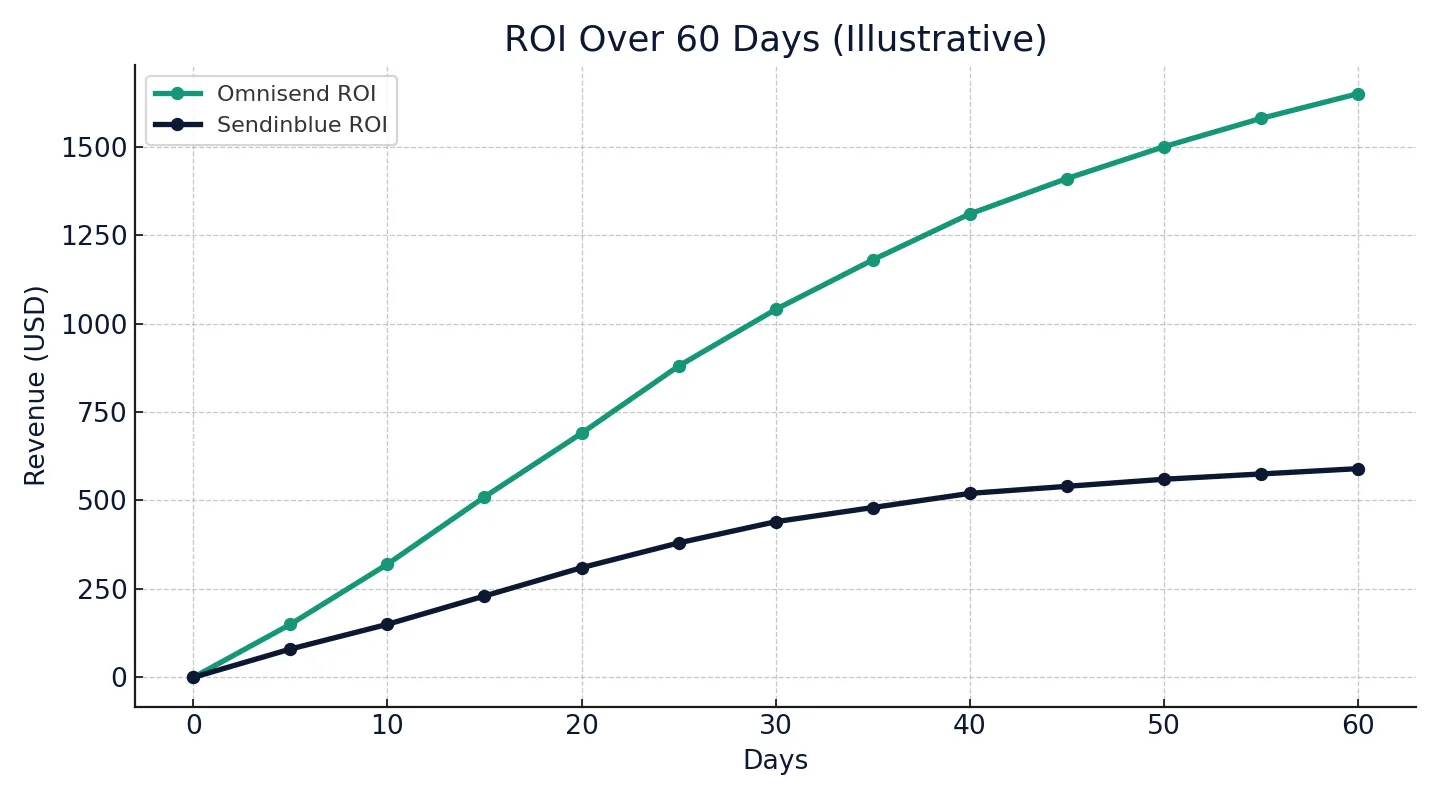
omnisend vs sendinblue 2025 ROI: which platform pays back faster?
For SMB ecommerce stores, ROI comes from:
- how fast you launch automations
- how many flows you activate
- whether SMS is used strategically
- how clear the attribution is
Omnisend pays back faster because:
- automations activate in hours, not days
- SMS boosts recovery conversions
- attribution clearly shows flow revenue
- prebuilt flows reduce manual time
Validate revenue in weeks, not months. No dev team required — ready ecommerce flows.
Takes minutes to connect Shopify/Woo. Cancel anytime.
Final verdict omnisend vs sendinblue 2025: which platform should ecommerce SMBs choose in 2025?
Both Omnisend and Sendinblue (Brevo) offer strong tools, but their core philosophies are completely different:
- Omnisend = ecommerce automation engine → fast ROI, revenue flows, SMS, segmentation, attribution.
- Sendinblue = communication suite → email, SMS, WhatsApp, CRM, broad business usage.
If you’re running a Shopify or WooCommerce store and you want the fastest path to revenue with ready-made automations and deep ecommerce analytics:
Omnisend wins this 2025 automation showdown.
If you need a multi-channel communication tool and don’t require advanced ecommerce flows, Sendinblue is a flexible option — but you’ll spend more time setting things up.
For 2025, Omnisend delivers more revenue with less work — especially for SMB ecommerce teams.
Recommended next:
Omnisend advanced segmentation (2025): repeat customer triggers
Launch your highest-performing ecommerce flows today.
Fully native for Shopify & WooCommerce. Cancel anytime.
FAQ: Omnisend vs Sendinblue 2025
1. Which tool is better for Shopify and WooCommerce?
Omnisend — it has deeper ecommerce event sync, product feeds, and prebuilt revenue flows.
2. Which platform is easier to use?
Omnisend. Sendinblue is simple for email but more complex for ecommerce automations.
3. Which has better SMS automation?
Omnisend — SMS is native, predictable, and integrated into flows.
4. Which is cheaper?
Sendinblue starts cheaper.
Omnisend’s value comes from ecommerce flows and included SMS credits on Pro plans.
5. Which offers better ROI?
Omnisend. Faster launch, deeper automations, clearer revenue attribution.
Popular comparison:
Omnisend vs HubSpot (2025): small business CRM comparison